

ITM3054
ITM3054
ITM3054
from
$447.00
Price in reward points: 447
- Catalog: ITM3054
- Gene/Protein: KRT7
- Product Description: Immunotag™ CK7 Monoclonal Antibody(12D7)
-
Description
-
Specifications
Antibody Specification Datasheet 
IMPORTANT NOTE This product is custom manufactured with a lead time of 3-4 weeks. Once in production, this item cannot be cancelled from an order and is not eligible for return. Target Protein CK7 (12D7) Clonality Monoclonal Storage/Stability -20°C/1 year Application IF,WB,IHC-p,IP Recommended Dilution IF: 1:50-200 WB: 1:1000-2000 IHC: 1:200 IP:1:200 Concentration 1 mg/ml Reactive Species Human,Mouse,Rat Host Species Mouse Immunogen Synthetic Peptide of CK7 Specificity The antibody detects endogenous CK7 proteins. Purification The antibody was affinity-purified from mouse ascites by affinity-chromatography using specific immunogen Form PBS, pH 7.4, containing 0.02% sodium azide as Preservative and 50% Glycerol. Gene Name KRT7 Accession No. P08729 Q9DCV7 Q6IG12 Alternate Names KRT7; SCL; Keratin, type II cytoskeletal 7; Cytokeratin-7; CK-7; Keratin-7; K7; Sarcolectin; Type-II keratin Kb7 Description keratin 7(KRT7) Homo sapiens The protein encoded by this gene is a member of the keratin gene family. The type II cytokeratins consist of basic or neutral proteins which are arranged in pairs of heterotypic keratin chains coexpressed during differentiation of simple and stratified epithelial tissues. This type II cytokeratin is specifically expressed in the simple epithelia lining the cavities of the internal organs and in the gland ducts and blood vessels. The genes encoding the type II cytokeratins are clustered in a region of chromosome 12q12-q13. Alternative splicing may result in several transcript variants; however, not all variants have been fully described. [provided by RefSeq, Jul 2008], Protein Expression Colon carcinoma,Epithelium,Keratinocyte,Mammary cancer,Mesothelium,Ovarian carcinoma,Pancreas,PCR r Subcellular Localization nucleus,cytoplasm,intermediate filament,keratin filament,extracellular exosome, Protein Function function:Blocks interferon-dependent interphase and stimulates DNA synthesis in cells. Involved in the translational regulation of the human papillomavirus type 16 E7 mRNA (HPV16 E7).,induction:Up-regulated by retinoic acid.,mass spectrometry: PubMed:11840567,miscellaneous:There are two types of cytoskeletal and microfibrillar keratin: I (acidic; 40-55 kDa) and II (neutral to basic; 56-70 kDa).,PTM:Arg-20 is dimethylated, probably to asymmetric dimethylarginine.,similarity:Belongs to the intermediate filament family.,subunit:Heterotetramer of two type I and two type II keratins. Interacts with eukaryotic translation initiator factor 3 (eIF3) subunit EIF3S10 and with HPV16 E7.,tissue specificity:Expressed in cultured epidermal, bronchial and mesothelial cells but absent in colon, ectocervix and liver. Observed throughout the glandular cells in the junction between stomach and esophagus but is absent in the esophagus., Usage For Research Use Only! Not for diagnostic or therapeutic procedures. - Reviews
| Antibody Specification | |
| Datasheet | |
| IMPORTANT NOTE | This product is custom manufactured with a lead time of 3-4 weeks. Once in production, this item cannot be cancelled from an order and is not eligible for return. |
| Target Protein | CK7 (12D7) |
| Clonality | Monoclonal |
| Storage/Stability | -20°C/1 year |
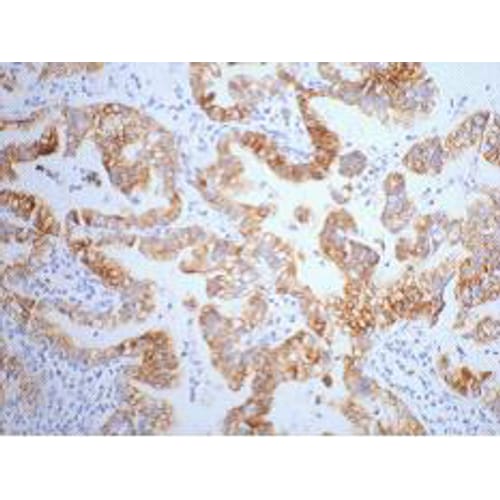
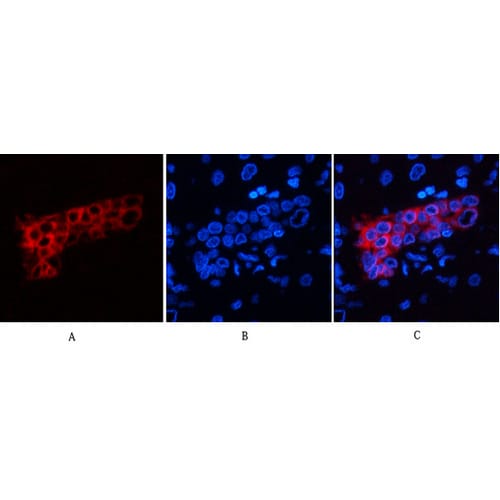
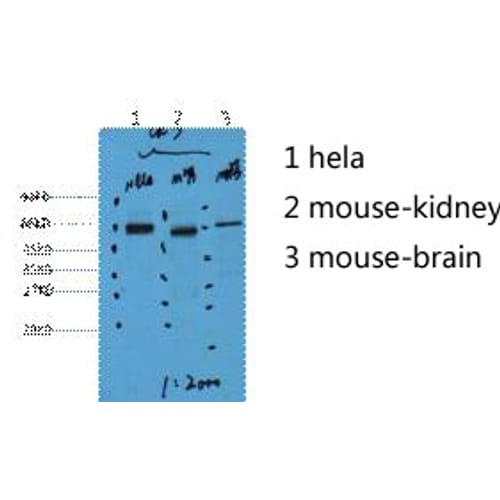
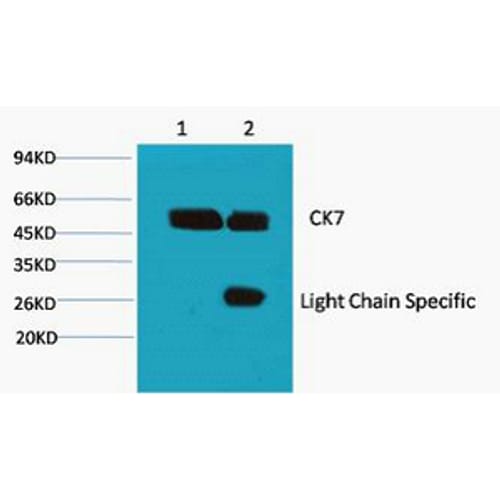
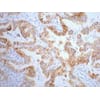
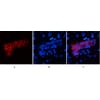
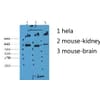
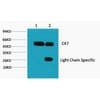
| Application | IF,WB,IHC-p,IP |
| Recommended Dilution | IF: 1:50-200 WB: 1:1000-2000 IHC: 1:200 IP:1:200 |
| Concentration | 1 mg/ml |
| Reactive Species | Human,Mouse,Rat |
| Host Species | Mouse |
| Immunogen | Synthetic Peptide of CK7 |
| Specificity | The antibody detects endogenous CK7 proteins. |
| Purification | The antibody was affinity-purified from mouse ascites by affinity-chromatography using specific immunogen |
| Form | PBS, pH 7.4, containing 0.02% sodium azide as Preservative and 50% Glycerol. |
| Gene Name | KRT7 |
| Accession No. | P08729 Q9DCV7 Q6IG12 |
| Alternate Names | KRT7; SCL; Keratin, type II cytoskeletal 7; Cytokeratin-7; CK-7; Keratin-7; K7; Sarcolectin; Type-II keratin Kb7 |
| Description | keratin 7(KRT7) Homo sapiens The protein encoded by this gene is a member of the keratin gene family. The type II cytokeratins consist of basic or neutral proteins which are arranged in pairs of heterotypic keratin chains coexpressed during differentiation of simple and stratified epithelial tissues. This type II cytokeratin is specifically expressed in the simple epithelia lining the cavities of the internal organs and in the gland ducts and blood vessels. The genes encoding the type II cytokeratins are clustered in a region of chromosome 12q12-q13. Alternative splicing may result in several transcript variants; however, not all variants have been fully described. [provided by RefSeq, Jul 2008], |
| Protein Expression | Colon carcinoma,Epithelium,Keratinocyte,Mammary cancer,Mesothelium,Ovarian carcinoma,Pancreas,PCR r |
| Subcellular Localization | nucleus,cytoplasm,intermediate filament,keratin filament,extracellular exosome, |
| Protein Function | function:Blocks interferon-dependent interphase and stimulates DNA synthesis in cells. Involved in the translational regulation of the human papillomavirus type 16 E7 mRNA (HPV16 E7).,induction:Up-regulated by retinoic acid.,mass spectrometry: PubMed:11840567,miscellaneous:There are two types of cytoskeletal and microfibrillar keratin: I (acidic; 40-55 kDa) and II (neutral to basic; 56-70 kDa).,PTM:Arg-20 is dimethylated, probably to asymmetric dimethylarginine.,similarity:Belongs to the intermediate filament family.,subunit:Heterotetramer of two type I and two type II keratins. Interacts with eukaryotic translation initiator factor 3 (eIF3) subunit EIF3S10 and with HPV16 E7.,tissue specificity:Expressed in cultured epidermal, bronchial and mesothelial cells but absent in colon, ectocervix and liver. Observed throughout the glandular cells in the junction between stomach and esophagus but is absent in the esophagus., |
| Usage | For Research Use Only! Not for diagnostic or therapeutic procedures. |