

ITM3158
ITM3158
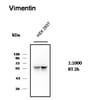
ITM3158
from
$447.00
Price in reward points: 447
- Catalog: ITM3158
- Gene/Protein: VIM
- Product Description: Immunotag™ Vimentin Monoclonal Antibody(1A7)
-
Description
-
Specifications
Antibody Specification Datasheet 
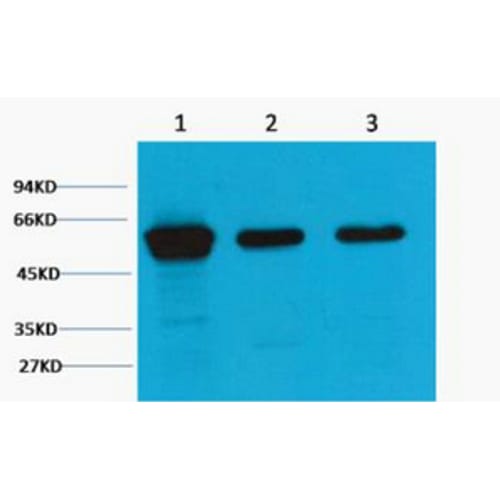
IMPORTANT NOTE This product is custom manufactured with a lead time of 3-4 weeks. Once in production, this item cannot be cancelled from an order and is not eligible for return. Target Protein Vimentin (1A7) Clonality Monoclonal Storage/Stability -20°C/1 year Application WB Recommended Dilution WB: 1:1000-3000 Concentration 1 mg/ml Reactive Species Human,Mouse,Rat Host Species Mouse Immunogen Recombinant Protein of Vimentin Specificity The antibody detects endogenous Vimentin protein. Purification The antibody was affinity-purified from mouse ascites by affinity-chromatography using specific immunogen Form PBS, pH 7.4, containing 0.02% sodium azide as Preservative and 50% Glycerol. Gene Name VIM Accession No. P08670 P20152 P31000 Alternate Names VIM; Vimentin Description vimentin(VIM) Homo sapiens This gene encodes a member of the intermediate filament family. Intermediate filamentents, along with microtubules and actin microfilaments, make up the cytoskeleton. The protein encoded by this gene is responsible for maintaining cell shape, integrity of the cytoplasm, and stabilizing cytoskeletal interactions. It is also involved in the immune response, and controls the transport of low-density lipoprotein (LDL)-derived cholesterol from a lysosome to the site of esterification. It functions as an organizer of a number of critical proteins involved in attachment, migration, and cell signaling. Mutations in this gene causes a dominant, pulverulent cataract.[provided by RefSeq, Jun 2009], Protein Expression Adipose tissue,Brain,Cajal-Retzius cell,Cervix,Coronary artery,Embryo,Epithelium,Fetal brain cortex Subcellular Localization cytoplasm,peroxisome,cytosol,cytoskeleton,intermediate filament,plasma membrane,focal adhesion,extracellular matrix,cell leading edge,neuron projection,intermediate filament cytoskeleton,extracellular exosome, Protein Function function:Vimentins are class-III intermediate filaments found in various non-epithelial cells, especially mesenchymal cells.,online information:Vimentin entry,PTM:One of the most prominent phosphoproteins in various cells of mesenchymal origin. Phosphorylation is enhanced during cell division, at which time vimentin filaments are significantly reorganized.,sequence caution:Intron retention.,similarity:Belongs to the intermediate filament family.,subunit:Homopolymer. Interacts with HCV core protein. Interacts with LGSN and SYNM.,tissue specificity:Highly expressed in fibroblasts, some expression in T- and B-lymphocytes, and little or no expression in Burkitt's lymphoma cell lines. Expressed in many hormone-independent mammary carcinoma cell lines., Usage For Research Use Only! Not for diagnostic or therapeutic procedures. - Reviews
| Antibody Specification | |
| Datasheet | |
| IMPORTANT NOTE | This product is custom manufactured with a lead time of 3-4 weeks. Once in production, this item cannot be cancelled from an order and is not eligible for return. |
| Target Protein | Vimentin (1A7) |
| Clonality | Monoclonal |
| Storage/Stability | -20°C/1 year |
| Application | WB |
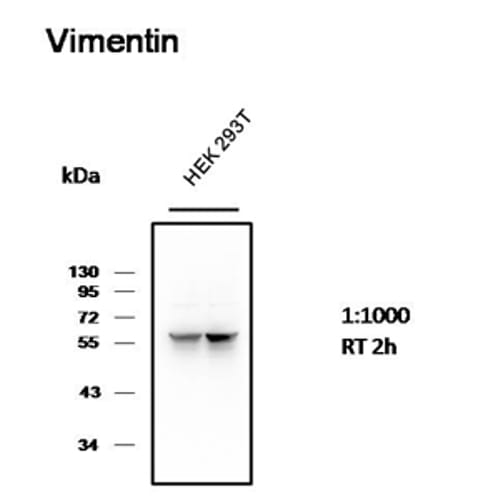
| Recommended Dilution | WB: 1:1000-3000 |
| Concentration | 1 mg/ml |
| Reactive Species | Human,Mouse,Rat |
| Host Species | Mouse |
| Immunogen | Recombinant Protein of Vimentin |
| Specificity | The antibody detects endogenous Vimentin protein. |
| Purification | The antibody was affinity-purified from mouse ascites by affinity-chromatography using specific immunogen |
| Form | PBS, pH 7.4, containing 0.02% sodium azide as Preservative and 50% Glycerol. |
| Gene Name | VIM |
| Accession No. | P08670 P20152 P31000 |
| Alternate Names | VIM; Vimentin |
| Description | vimentin(VIM) Homo sapiens This gene encodes a member of the intermediate filament family. Intermediate filamentents, along with microtubules and actin microfilaments, make up the cytoskeleton. The protein encoded by this gene is responsible for maintaining cell shape, integrity of the cytoplasm, and stabilizing cytoskeletal interactions. It is also involved in the immune response, and controls the transport of low-density lipoprotein (LDL)-derived cholesterol from a lysosome to the site of esterification. It functions as an organizer of a number of critical proteins involved in attachment, migration, and cell signaling. Mutations in this gene causes a dominant, pulverulent cataract.[provided by RefSeq, Jun 2009], |
| Protein Expression | Adipose tissue,Brain,Cajal-Retzius cell,Cervix,Coronary artery,Embryo,Epithelium,Fetal brain cortex |
| Subcellular Localization | cytoplasm,peroxisome,cytosol,cytoskeleton,intermediate filament,plasma membrane,focal adhesion,extracellular matrix,cell leading edge,neuron projection,intermediate filament cytoskeleton,extracellular exosome, |
| Protein Function | function:Vimentins are class-III intermediate filaments found in various non-epithelial cells, especially mesenchymal cells.,online information:Vimentin entry,PTM:One of the most prominent phosphoproteins in various cells of mesenchymal origin. Phosphorylation is enhanced during cell division, at which time vimentin filaments are significantly reorganized.,sequence caution:Intron retention.,similarity:Belongs to the intermediate filament family.,subunit:Homopolymer. Interacts with HCV core protein. Interacts with LGSN and SYNM.,tissue specificity:Highly expressed in fibroblasts, some expression in T- and B-lymphocytes, and little or no expression in Burkitt's lymphoma cell lines. Expressed in many hormone-independent mammary carcinoma cell lines., |
| Usage | For Research Use Only! Not for diagnostic or therapeutic procedures. |