

ITM3417
ITM3417
ITM3417
from
$424.00
Price in reward points: 424
- Catalog: ITM3417
- Gene/Protein: SMAD3
- Product Description: Immunotag™ Smad3 Polyclonal Antibody
-
Description
-
Specifications
Antibody Specification Datasheet 
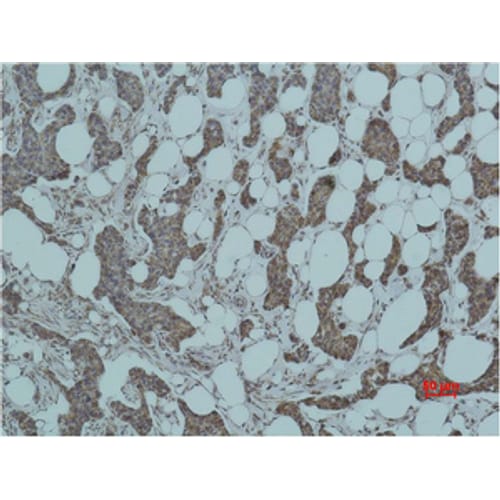
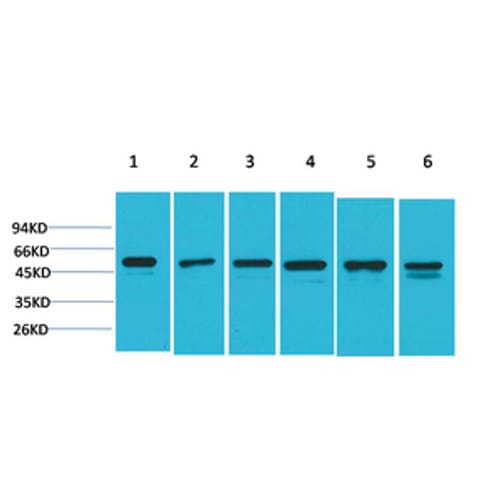
IMPORTANT NOTE This product is custom manufactured with a lead time of 3-4 weeks. Once in production, this item cannot be cancelled from an order and is not eligible for return. Target Protein SMAD3 Clonality Polyclonal Storage/Stability -20°C/1 year Application WB,IHC-p Recommended Dilution Western Blot: 1/500 - 1/2000.IHC-p:1:50-300. Not yet tested in other applications. Concentration 1 mg/ml Reactive Species Human,Mouse,Rat Host Species Rabbit Immunogen Synthesized peptide derived from human Smad3 around the non-phosphorylation site of S213. Specificity The antibody detects endogenous Smad3 protein. Purification The antibody was affinity-purified from rabbit antiserum by affinity-chromatography using epitope-specific immunogen Form PBS, pH 7.4, containing 0.02% sodium azide as Preservative and 50% Glycerol. Gene Name SMAD3 Accession No. P84022 Q8BUN5 P84025 Alternate Names SMAD3; MADH3; Mothers against decapentaplegic homolog 3; MAD homolog 3; Mad3; Mothers against DPP homolog 3; hMAD-3; JV15-2; SMAD family member 3; SMAD 3; Smad3; hSMAD3 Description SMAD family member 3(SMAD3) Homo sapiens The protein encoded by this gene belongs to the SMAD, a family of proteins similar to the gene products of the Drosophila gene 'mothers against decapentaplegic' (Mad) and the C. elegans gene Sma. SMAD proteins are signal transducers and transcriptional modulators that mediate multiple signaling pathways. This protein functions as a transcriptional modulator activated by transforming growth factor-beta and is thought to play a role in the regulation of carcinogenesis. [provided by RefSeq, Apr 2009], Cell Pathway/ Category Cell_Cycle_G1S,Cell_Cycle_G2M_DNA,WNT,WNT-T CELLTGF-beta,Adherens_Junction,Pathways in cancer,Colorectal cancer,Pancreatic cancer,Chronic myeloid leukemia, Protein Expression Brain,Colon carcinoma,Esophagus tumor,Pancreas,Placenta,Spleen,Umbilical cord blood Subcellular Localization nuclear chromatin,intracellular,nucleus,nuclear inner membrane,nucleoplasm,transcription factor complex,cytoplasm,cytosol,plasma membrane,receptor complex,SMAD protein complex,SMAD2-SMAD3 protein complex, Protein Function disease:Defects in SMAD3 may be a cause of colorectal cancer (CRC) [MIM:114500].,domain:The MH2 domain is sufficient to carry protein nuclear export.,function:Transcriptional modulator activated by TGF-beta (transforming growth factor) and activin type 1 receptor kinase. SMAD3 is a receptor-regulated SMAD (R-SMAD).,PTM:Phosphorylated on serine by TGF-beta and activin type 1 receptor kinases.,similarity:Belongs to the dwarfin/SMAD family.,similarity:Contains 1 MH1 (MAD homology 1) domain.,similarity:Contains 1 MH2 (MAD homology 2) domain.,subcellular location:In the cytoplasm in the absence of ligand. Migration to the nucleus when complexed with Smad4.,subunit:Interacts with HGS. Interacts with NEDD4L in response to TGF-beta. Interacts with TTRAP (By similarity). Interacts with SARA (SMAD anchor for receptor activation); form trimers with another SMAD3 and the co-SMAD SMAD4. Interacts with JUN/FOS, vitamin D receptor, homeobox protein TGIF and TGIF2, PEBP2-alpha C subunit, CREB-binding protein (CBP), p300, SKI, SNON, ATF2, SMURF2, AIP1, DACH1 and TGFB1I1. Part of a complex consisting of AIP1, ACVR2A, ACVR1B and SMAD3. Found in a complex with SMAD2 and TRIM33 upon addition of TGF-beta. Interacts with SMAD2 and TRIM33. Found in a complex with SMAD3, Ran and XPO4. Interacts with XPO4. Interacts with LBXCOR1 and CORL2., Usage For Research Use Only! Not for diagnostic or therapeutic procedures. - Reviews
| Antibody Specification | |
| Datasheet | |
| IMPORTANT NOTE | This product is custom manufactured with a lead time of 3-4 weeks. Once in production, this item cannot be cancelled from an order and is not eligible for return. |
| Target Protein | SMAD3 |
| Clonality | Polyclonal |
| Storage/Stability | -20°C/1 year |
| Application | WB,IHC-p |
| Recommended Dilution | Western Blot: 1/500 - 1/2000.IHC-p:1:50-300. Not yet tested in other applications. |
| Concentration | 1 mg/ml |
| Reactive Species | Human,Mouse,Rat |
| Host Species | Rabbit |
| Immunogen | Synthesized peptide derived from human Smad3 around the non-phosphorylation site of S213. |
| Specificity | The antibody detects endogenous Smad3 protein. |
| Purification | The antibody was affinity-purified from rabbit antiserum by affinity-chromatography using epitope-specific immunogen |
| Form | PBS, pH 7.4, containing 0.02% sodium azide as Preservative and 50% Glycerol. |
| Gene Name | SMAD3 |
| Accession No. | P84022 Q8BUN5 P84025 |
| Alternate Names | SMAD3; MADH3; Mothers against decapentaplegic homolog 3; MAD homolog 3; Mad3; Mothers against DPP homolog 3; hMAD-3; JV15-2; SMAD family member 3; SMAD 3; Smad3; hSMAD3 |
| Description | SMAD family member 3(SMAD3) Homo sapiens The protein encoded by this gene belongs to the SMAD, a family of proteins similar to the gene products of the Drosophila gene 'mothers against decapentaplegic' (Mad) and the C. elegans gene Sma. SMAD proteins are signal transducers and transcriptional modulators that mediate multiple signaling pathways. This protein functions as a transcriptional modulator activated by transforming growth factor-beta and is thought to play a role in the regulation of carcinogenesis. [provided by RefSeq, Apr 2009], |
| Cell Pathway/ Category | Cell_Cycle_G1S,Cell_Cycle_G2M_DNA,WNT,WNT-T CELLTGF-beta,Adherens_Junction,Pathways in cancer,Colorectal cancer,Pancreatic cancer,Chronic myeloid leukemia, |
| Protein Expression | Brain,Colon carcinoma,Esophagus tumor,Pancreas,Placenta,Spleen,Umbilical cord blood |
| Subcellular Localization | nuclear chromatin,intracellular,nucleus,nuclear inner membrane,nucleoplasm,transcription factor complex,cytoplasm,cytosol,plasma membrane,receptor complex,SMAD protein complex,SMAD2-SMAD3 protein complex, |
| Protein Function | disease:Defects in SMAD3 may be a cause of colorectal cancer (CRC) [MIM:114500].,domain:The MH2 domain is sufficient to carry protein nuclear export.,function:Transcriptional modulator activated by TGF-beta (transforming growth factor) and activin type 1 receptor kinase. SMAD3 is a receptor-regulated SMAD (R-SMAD).,PTM:Phosphorylated on serine by TGF-beta and activin type 1 receptor kinases.,similarity:Belongs to the dwarfin/SMAD family.,similarity:Contains 1 MH1 (MAD homology 1) domain.,similarity:Contains 1 MH2 (MAD homology 2) domain.,subcellular location:In the cytoplasm in the absence of ligand. Migration to the nucleus when complexed with Smad4.,subunit:Interacts with HGS. Interacts with NEDD4L in response to TGF-beta. Interacts with TTRAP (By similarity). Interacts with SARA (SMAD anchor for receptor activation); form trimers with another SMAD3 and the co-SMAD SMAD4. Interacts with JUN/FOS, vitamin D receptor, homeobox protein TGIF and TGIF2, PEBP2-alpha C subunit, CREB-binding protein (CBP), p300, SKI, SNON, ATF2, SMURF2, AIP1, DACH1 and TGFB1I1. Part of a complex consisting of AIP1, ACVR2A, ACVR1B and SMAD3. Found in a complex with SMAD2 and TRIM33 upon addition of TGF-beta. Interacts with SMAD2 and TRIM33. Found in a complex with SMAD3, Ran and XPO4. Interacts with XPO4. Interacts with LBXCOR1 and CORL2., |
| Usage | For Research Use Only! Not for diagnostic or therapeutic procedures. |