

ITM3566
ITM3566
ITM3566
from
$424.00
Price in reward points: 424
- Catalog: ITM3566
- Gene/Protein: KCNN3
- Product Description: Immunotag™ KCNN3 (SK3) Polyclonal Antibody
-
Description
-
Specifications
Antibody Specification Datasheet 
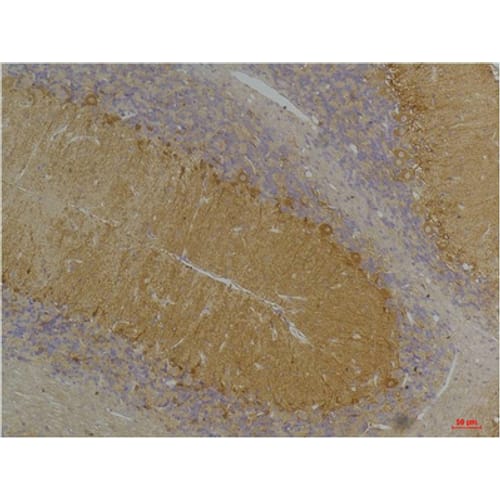
IMPORTANT NOTE This product is custom manufactured with a lead time of 3-4 weeks. Once in production, this item cannot be cancelled from an order and is not eligible for return. Target Protein KCNN3 (SK3) Clonality Polyclonal Storage/Stability -20°C/1 year Application IHC-p Recommended Dilution IHC 1:100-200 Concentration 1 mg/ml Reactive Species Human,Rat Host Species Rabbit Immunogen Synthetic Peptide of KCNN3 (SK3) Specificity KCNN3(SK3) protein(A246) detects endogenous levels of KCNN3(SK3) Purification The antibody was affinity-purified from rabbit antiserum by affinity-chromatography using specific immunogen Form Liquid in PBS containing 50% glycerol, 0.5% BSA and 0.02% sodium azide. Gene Name KCNN3 Accession No. Q9UGI6 P58391 P70605 Alternate Names Small conductance calcium-activated potassium channel protein 3 (SK3) (SKCa 3) (SKCa3) (KCa2.3) Description potassium calcium-activated channel subfamily N member 3(KCNN3) Homo sapiens Action potentials in vertebrate neurons are followed by an afterhyperpolarization (AHP) that may persist for several seconds and may have profound consequences for the firing pattern of the neuron. Each component of the AHP is kinetically distinct and is mediated by different calcium-activated potassium channels. This gene belongs to the KCNN family of potassium channels. It encodes an integral membrane protein that forms a voltage-independent calcium-activated channel, which is thought to regulate neuronal excitability by contributing to the slow component of synaptic AHP. This gene contains two CAG repeat regions in the coding sequence. It was thought that expansion of one or both of these repeats could lead to an increased susceptibility to schizophrenia or bipolar disorder, but studies indicate that this is probably not the case. Alternatively spliced transcript v Protein Expression Atrium,Lymph,Non-pregnant myometrium, Subcellular Localization cytoplasm,plasma membrane,integral component of membrane,neuronal cell body, Protein Function function:Forms a voltage-independent potassium channel activated by intracellular calcium. Activation is followed by membrane hyperpolarization. Thought to regulate neuronal excitability by contributing to the slow component of synaptic afterhyperpolarization. The channel is blocked by apamin.,polymorphism:The second poly-Gln region of KCNN3 is highly polymorphic and the number of Gln varies from 12 to 28 in the population.,similarity:Belongs to the potassium channel KCNN family.,subunit:Heterooligomer. The complex is composed of 4 channel subunits each of which binds to a calmodulin subunit which regulates the channel activity through calcium-binding., Usage For Research Use Only! Not for diagnostic or therapeutic procedures. - Reviews
| Antibody Specification | |
| Datasheet | |
| IMPORTANT NOTE | This product is custom manufactured with a lead time of 3-4 weeks. Once in production, this item cannot be cancelled from an order and is not eligible for return. |
| Target Protein | KCNN3 (SK3) |
| Clonality | Polyclonal |
| Storage/Stability | -20°C/1 year |
| Application | IHC-p |
| Recommended Dilution | IHC 1:100-200 |
| Concentration | 1 mg/ml |
| Reactive Species | Human,Rat |
| Host Species | Rabbit |
| Immunogen | Synthetic Peptide of KCNN3 (SK3) |
| Specificity | KCNN3(SK3) protein(A246) detects endogenous levels of KCNN3(SK3) |
| Purification | The antibody was affinity-purified from rabbit antiserum by affinity-chromatography using specific immunogen |
| Form | Liquid in PBS containing 50% glycerol, 0.5% BSA and 0.02% sodium azide. |
| Gene Name | KCNN3 |
| Accession No. | Q9UGI6 P58391 P70605 |
| Alternate Names | Small conductance calcium-activated potassium channel protein 3 (SK3) (SKCa 3) (SKCa3) (KCa2.3) |
| Description | potassium calcium-activated channel subfamily N member 3(KCNN3) Homo sapiens Action potentials in vertebrate neurons are followed by an afterhyperpolarization (AHP) that may persist for several seconds and may have profound consequences for the firing pattern of the neuron. Each component of the AHP is kinetically distinct and is mediated by different calcium-activated potassium channels. This gene belongs to the KCNN family of potassium channels. It encodes an integral membrane protein that forms a voltage-independent calcium-activated channel, which is thought to regulate neuronal excitability by contributing to the slow component of synaptic AHP. This gene contains two CAG repeat regions in the coding sequence. It was thought that expansion of one or both of these repeats could lead to an increased susceptibility to schizophrenia or bipolar disorder, but studies indicate that this is probably not the case. Alternatively spliced transcript v |
| Protein Expression | Atrium,Lymph,Non-pregnant myometrium, |
| Subcellular Localization | cytoplasm,plasma membrane,integral component of membrane,neuronal cell body, |
| Protein Function | function:Forms a voltage-independent potassium channel activated by intracellular calcium. Activation is followed by membrane hyperpolarization. Thought to regulate neuronal excitability by contributing to the slow component of synaptic afterhyperpolarization. The channel is blocked by apamin.,polymorphism:The second poly-Gln region of KCNN3 is highly polymorphic and the number of Gln varies from 12 to 28 in the population.,similarity:Belongs to the potassium channel KCNN family.,subunit:Heterooligomer. The complex is composed of 4 channel subunits each of which binds to a calmodulin subunit which regulates the channel activity through calcium-binding., |
| Usage | For Research Use Only! Not for diagnostic or therapeutic procedures. |