

ITM3632
ITM3632
ITM3632
from
$447.00
Price in reward points: 447
- Catalog: ITM3632
- Gene/Protein: MAPK1/MAPK3
- Product Description: Immunotag™ Phospho-ERK 1/2 (Y222/205)Mouse Monoclonal Antibody(4G3)
-
Description
-
Specifications
Antibody Specification Datasheet 
IMPORTANT NOTE This product is custom manufactured with a lead time of 3-4 weeks. Once in production, this item cannot be cancelled from an order and is not eligible for return. Target Protein ERK 1/2 (Y222/205) Clonality Monoclonal Storage/Stability -20°C/1 year Application IHC-p Recommended Dilution IHC 1:100-200 Concentration 1 mg/ml Reactive Species Human,Rat,Mouse Host Species Mouse Immunogen Synthetic Peptide of Phospho-ERK 1/2 (Y222/205) at AA range of 140-220 Specificity Phospho-ERK 1/2 (Y222/205)protein detects endogenous levels of MAPK1/MAPK3 Purification The antibody was affinity-purified from mouse ascites by affinity-chromatography using specific immunogen Form Liquid in PBS containing 50% glycerol, 0.5% BSA and 0.02% sodium azide. Gene Name MAPK1/MAPK3 Accession No. P27361/P28482 Alternate Names MAPK1/MAPK3 Description mitogen-activated protein kinase 3(MAPK3) Homo sapiens The protein encoded by this gene is a member of the MAP kinase family. MAP kinases, also known as extracellular signal-regulated kinases (ERKs), act in a signaling cascade that regulates various cellular processes such as proliferation, differentiation, and cell cycle progression in response to a variety of extracellular signals. This kinase is activated by upstream kinases, resulting in its translocation to the nucleus where it phosphorylates nuclear targets. Alternatively spliced transcript variants encoding different protein isoforms have been described. [provided by RefSeq, Jul 2008], Cell Pathway/ Category MAPK_ERK_Growth,MAPK_G_Protein,ErbB_HER,Chemokine,Oocyte meiosis,mTOR,Vascular smooth muscle contraction,Dorso-ventral axis formation,TGF-beta,Axon guidance,VEGF,Focal adhesion,Adherens_Junction,Gap junction,Toll_Like,NOD-like receptor,Natural killer cell mediated cytotoxicity,T_Cell_Receptor,B_Cell_Antigen,Fc epsilon RI,Fc gamma R-mediated phagocytosis,Long-term potentiation,Neurotrophin,Long-term depression,Regulates Actin and Cytoskeleton,Insulin_Receptor,GnRH,Progesterone-mediated oocyte maturation,Melanogenesis,Type II diabetes mellitus,Aldosterone-regulated sodium reabsorption,Alzheimer's disease,Prion diseases,Pathways in cancer,Colorectal cancer,Renal cell carcinoma,Pancreatic cancer,Endometrial cancer,Glioma,Prostate cancer,Thyroid cancer,Melanoma,Bladder cancer,Chronic myeloid leukemia,Acute myeloid leukemia,Non-small cell lung cancer, Protein Expression Epithelium,Eye,Hepatoma,Human cervix,Lymph, Subcellular Localization intracellular,nucleus,nuclear envelope,nucleoplasm,mitochondrion,early endosome,late endosome,Golgi apparatus,cytosol,cytoskeleton,caveola,focal adhesion,microtubule cytoskeleton,pseudopodiu Protein Function catalytic activity:ATP + a protein = ADP + a phosphoprotein.,cofactor:Magnesium.,domain:The TXY motif contains the threonine and tyrosine residues whose phosphorylation activates the MAP kinases.,enzyme regulation:Activated by tyrosine phosphorylation in response to insulin and NGF.,function:Involved in both the initiation and regulation of meiosis, mitosis, and postmitotic functions in differentiated cells by phosphorylating a number of transcription factors such as ELK-1. Phosphorylates EIF4EBP1; required for initiation of translation. Phosphorylates microtubule-associated protein 2 (MAP2). Phosphorylates SPZ1 (By similarity). Phosphorylates heat shock factor protein 4 (HSF4).,PTM:Dually phosphorylated on Thr-202 and Tyr-204, which activates the enzyme.,similarity:Belongs to the protein kinase superfamily.,similarity:Belongs to the protein kinase superfamily. CMGC Ser/Thr protein kinase family. MAP kinase subfamily.,similarity:Contains 1 protein kinase domain.,subunit:Interacts with MORG1 (By similarity). Binds to HIV-1 Nef. This interaction inhibits its kinase activity. Interacts with HSF4 and NISCH., Usage For Research Use Only! Not for diagnostic or therapeutic procedures. - Reviews
| Antibody Specification | |
| Datasheet | |
| IMPORTANT NOTE | This product is custom manufactured with a lead time of 3-4 weeks. Once in production, this item cannot be cancelled from an order and is not eligible for return. |
| Target Protein | ERK 1/2 (Y222/205) |
| Clonality | Monoclonal |
| Storage/Stability | -20°C/1 year |
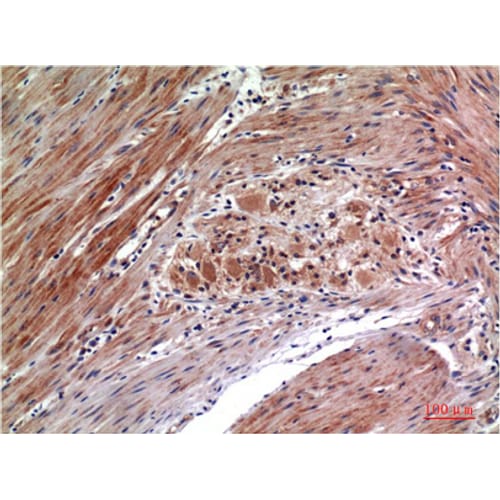
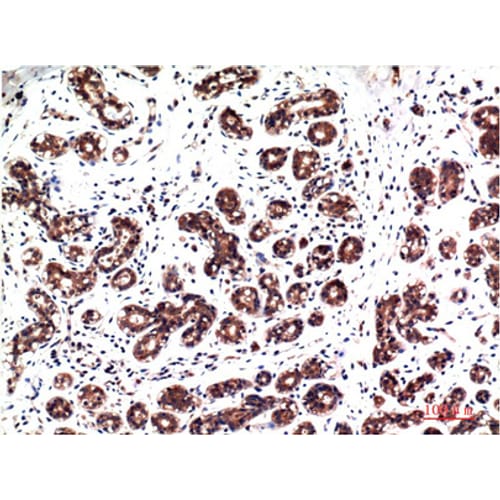
| Application | IHC-p |
| Recommended Dilution | IHC 1:100-200 |
| Concentration | 1 mg/ml |
| Reactive Species | Human,Rat,Mouse |
| Host Species | Mouse |
| Immunogen | Synthetic Peptide of Phospho-ERK 1/2 (Y222/205) at AA range of 140-220 |
| Specificity | Phospho-ERK 1/2 (Y222/205)protein detects endogenous levels of MAPK1/MAPK3 |
| Purification | The antibody was affinity-purified from mouse ascites by affinity-chromatography using specific immunogen |
| Form | Liquid in PBS containing 50% glycerol, 0.5% BSA and 0.02% sodium azide. |
| Gene Name | MAPK1/MAPK3 |
| Accession No. | P27361/P28482 |
| Alternate Names | MAPK1/MAPK3 |
| Description | mitogen-activated protein kinase 3(MAPK3) Homo sapiens The protein encoded by this gene is a member of the MAP kinase family. MAP kinases, also known as extracellular signal-regulated kinases (ERKs), act in a signaling cascade that regulates various cellular processes such as proliferation, differentiation, and cell cycle progression in response to a variety of extracellular signals. This kinase is activated by upstream kinases, resulting in its translocation to the nucleus where it phosphorylates nuclear targets. Alternatively spliced transcript variants encoding different protein isoforms have been described. [provided by RefSeq, Jul 2008], |
| Cell Pathway/ Category | MAPK_ERK_Growth,MAPK_G_Protein,ErbB_HER,Chemokine,Oocyte meiosis,mTOR,Vascular smooth muscle contraction,Dorso-ventral axis formation,TGF-beta,Axon guidance,VEGF,Focal adhesion,Adherens_Junction,Gap junction,Toll_Like,NOD-like receptor,Natural killer cell mediated cytotoxicity,T_Cell_Receptor,B_Cell_Antigen,Fc epsilon RI,Fc gamma R-mediated phagocytosis,Long-term potentiation,Neurotrophin,Long-term depression,Regulates Actin and Cytoskeleton,Insulin_Receptor,GnRH,Progesterone-mediated oocyte maturation,Melanogenesis,Type II diabetes mellitus,Aldosterone-regulated sodium reabsorption,Alzheimer's disease,Prion diseases,Pathways in cancer,Colorectal cancer,Renal cell carcinoma,Pancreatic cancer,Endometrial cancer,Glioma,Prostate cancer,Thyroid cancer,Melanoma,Bladder cancer,Chronic myeloid leukemia,Acute myeloid leukemia,Non-small cell lung cancer, |
| Protein Expression | Epithelium,Eye,Hepatoma,Human cervix,Lymph, |
| Subcellular Localization | intracellular,nucleus,nuclear envelope,nucleoplasm,mitochondrion,early endosome,late endosome,Golgi apparatus,cytosol,cytoskeleton,caveola,focal adhesion,microtubule cytoskeleton,pseudopodiu |
| Protein Function | catalytic activity:ATP + a protein = ADP + a phosphoprotein.,cofactor:Magnesium.,domain:The TXY motif contains the threonine and tyrosine residues whose phosphorylation activates the MAP kinases.,enzyme regulation:Activated by tyrosine phosphorylation in response to insulin and NGF.,function:Involved in both the initiation and regulation of meiosis, mitosis, and postmitotic functions in differentiated cells by phosphorylating a number of transcription factors such as ELK-1. Phosphorylates EIF4EBP1; required for initiation of translation. Phosphorylates microtubule-associated protein 2 (MAP2). Phosphorylates SPZ1 (By similarity). Phosphorylates heat shock factor protein 4 (HSF4).,PTM:Dually phosphorylated on Thr-202 and Tyr-204, which activates the enzyme.,similarity:Belongs to the protein kinase superfamily.,similarity:Belongs to the protein kinase superfamily. CMGC Ser/Thr protein kinase family. MAP kinase subfamily.,similarity:Contains 1 protein kinase domain.,subunit:Interacts with MORG1 (By similarity). Binds to HIV-1 Nef. This interaction inhibits its kinase activity. Interacts with HSF4 and NISCH., |
| Usage | For Research Use Only! Not for diagnostic or therapeutic procedures. |