

ITM3688
ITM3688
ITM3688
from
$447.00
Price in reward points: 447
- Catalog: ITM3688
- Gene/Protein: PDGFRA
- Product Description: Immunotag™ PDGFRα mouse Monoclonal Antibody(4G11)
-
Description
-
Specifications
Antibody Specification Datasheet 
IMPORTANT NOTE This product is custom manufactured with a lead time of 3-4 weeks. Once in production, this item cannot be cancelled from an order and is not eligible for return. Target Protein PDGFRα (4G11) Clonality Monoclonal Storage/Stability -20°C/1 year Application IHC-p Recommended Dilution IHC 1:100-200 Concentration 1 mg/ml Reactive Species Human,Rat,Mouse Host Species Mouse Immunogen Synthetic Peptide of PDGFRα at AA range of 1010-1090 Specificity PDGFRα protein detects endogenous levels of PDGFRA Purification The antibody was affinity-purified from mouse ascites by affinity-chromatography using specific immunogen Form Liquid in PBS containing 50% glycerol, 0.5% BSA and 0.02% sodium azide. Gene Name PDGFRA Accession No. P16234 P26618 P20786 Alternate Names PDGFRA Description platelet derived growth factor receptor alpha(PDGFRA) Homo sapiens This gene encodes a cell surface tyrosine kinase receptor for members of the platelet-derived growth factor family. These growth factors are mitogens for cells of mesenchymal origin. The identity of the growth factor bound to a receptor monomer determines whether the functional receptor is a homodimer or a heterodimer, composed of both platelet-derived growth factor receptor alpha and beta polypeptides. Studies suggest that this gene plays a role in organ development, wound healing, and tumor progression. Mutations in this gene have been associated with idiopathic hypereosinophilic syndrome, somatic and familial gastrointestinal stromal tumors, and a variety of other cancers. [provided by RefSeq, Mar 2012], Cell Pathway/ Category MAPK_ERK_Growth,MAPK_G_Protein,Calcium,Cytokine-cytokine receptor interaction,Endocytosis,Focal adhesion,Gap junction,Regulates Actin and Cytoskeleton,Pathways in cancer,Colorectal cancer,Glioma,Prostate cancer,Melanoma, Protein Expression Blood,Brain,Colon tumor,Eosinophil,Foreskin,Lung,Placenta,T Subcellular Localization nucleus,cytoplasm,plasma membrane,integral component of plasma membrane,membrane,intrinsic component of plasma membrane,protein complex, Protein Function catalytic activity:ATP + a [protein]-L-tyrosine = ADP + a [protein]-L-tyrosine phosphate.,disease:A fusion of PDGFRA and FIP1L1 (FIP1L1-PDGFRA), due to an interstitial chromosomal deletion, is the cause of some cases of hypereosinophilic syndrome (HES) [MIM:607685]. HES is a rare hematologic disorder characterized by sustained overproduction of eosinophils in the bone marrow, eosinophilia, tissue infiltration and organ damage.,function:Receptor that binds both PDGFA and PDGFB and has a tyrosine-protein kinase activity.,similarity:Belongs to the protein kinase superfamily. Tyr protein kinase family. CSF-1/PDGF receptor subfamily.,similarity:Contains 1 protein kinase domain.,similarity:Contains 5 Ig-like C2-type (immunoglobulin-like) domains.,subunit:Homodimer, and heterodimer with PDGFRB. Interacts with the SH2 domain of SHB via phosphorylated Tyr-720 (By similarity). Interacts with the SH2 domain of SHF via phosphorylated Tyr-720.,tissue specificity:Expressed in primary and metastatic colon tumors and in normal colon tissue. Tumors may express a different isoform to that found in normal tissue., Usage For Research Use Only! Not for diagnostic or therapeutic procedures. - Reviews
| Antibody Specification | |
| Datasheet | |
| IMPORTANT NOTE | This product is custom manufactured with a lead time of 3-4 weeks. Once in production, this item cannot be cancelled from an order and is not eligible for return. |
| Target Protein | PDGFRα (4G11) |
| Clonality | Monoclonal |
| Storage/Stability | -20°C/1 year |
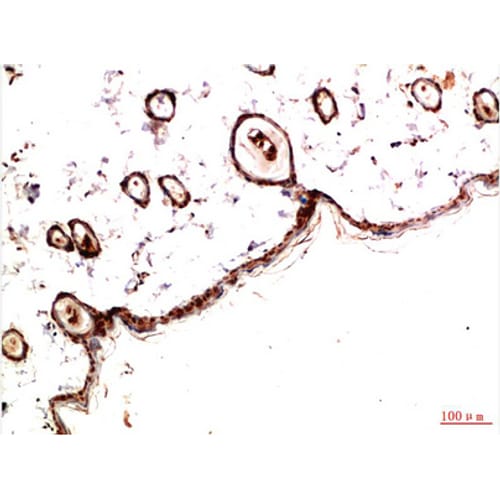
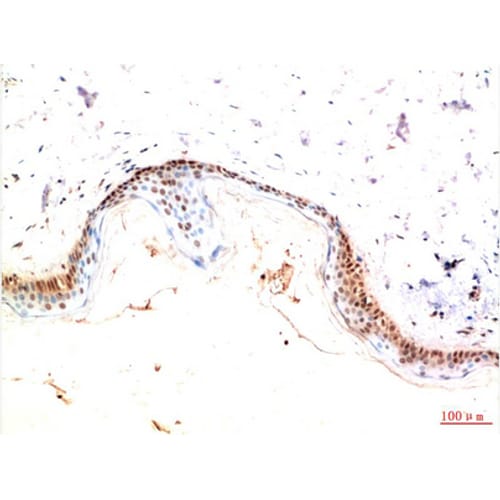
| Application | IHC-p |
| Recommended Dilution | IHC 1:100-200 |
| Concentration | 1 mg/ml |
| Reactive Species | Human,Rat,Mouse |
| Host Species | Mouse |
| Immunogen | Synthetic Peptide of PDGFRα at AA range of 1010-1090 |
| Specificity | PDGFRα protein detects endogenous levels of PDGFRA |
| Purification | The antibody was affinity-purified from mouse ascites by affinity-chromatography using specific immunogen |
| Form | Liquid in PBS containing 50% glycerol, 0.5% BSA and 0.02% sodium azide. |
| Gene Name | PDGFRA |
| Accession No. | P16234 P26618 P20786 |
| Alternate Names | PDGFRA |
| Description | platelet derived growth factor receptor alpha(PDGFRA) Homo sapiens This gene encodes a cell surface tyrosine kinase receptor for members of the platelet-derived growth factor family. These growth factors are mitogens for cells of mesenchymal origin. The identity of the growth factor bound to a receptor monomer determines whether the functional receptor is a homodimer or a heterodimer, composed of both platelet-derived growth factor receptor alpha and beta polypeptides. Studies suggest that this gene plays a role in organ development, wound healing, and tumor progression. Mutations in this gene have been associated with idiopathic hypereosinophilic syndrome, somatic and familial gastrointestinal stromal tumors, and a variety of other cancers. [provided by RefSeq, Mar 2012], |
| Cell Pathway/ Category | MAPK_ERK_Growth,MAPK_G_Protein,Calcium,Cytokine-cytokine receptor interaction,Endocytosis,Focal adhesion,Gap junction,Regulates Actin and Cytoskeleton,Pathways in cancer,Colorectal cancer,Glioma,Prostate cancer,Melanoma, |
| Protein Expression | Blood,Brain,Colon tumor,Eosinophil,Foreskin,Lung,Placenta,T |
| Subcellular Localization | nucleus,cytoplasm,plasma membrane,integral component of plasma membrane,membrane,intrinsic component of plasma membrane,protein complex, |
| Protein Function | catalytic activity:ATP + a [protein]-L-tyrosine = ADP + a [protein]-L-tyrosine phosphate.,disease:A fusion of PDGFRA and FIP1L1 (FIP1L1-PDGFRA), due to an interstitial chromosomal deletion, is the cause of some cases of hypereosinophilic syndrome (HES) [MIM:607685]. HES is a rare hematologic disorder characterized by sustained overproduction of eosinophils in the bone marrow, eosinophilia, tissue infiltration and organ damage.,function:Receptor that binds both PDGFA and PDGFB and has a tyrosine-protein kinase activity.,similarity:Belongs to the protein kinase superfamily. Tyr protein kinase family. CSF-1/PDGF receptor subfamily.,similarity:Contains 1 protein kinase domain.,similarity:Contains 5 Ig-like C2-type (immunoglobulin-like) domains.,subunit:Homodimer, and heterodimer with PDGFRB. Interacts with the SH2 domain of SHB via phosphorylated Tyr-720 (By similarity). Interacts with the SH2 domain of SHF via phosphorylated Tyr-720.,tissue specificity:Expressed in primary and metastatic colon tumors and in normal colon tissue. Tumors may express a different isoform to that found in normal tissue., |
| Usage | For Research Use Only! Not for diagnostic or therapeutic procedures. |