

ITP0279
ITP0279
ITP0279
from
$541.00
Price in reward points: 541
- Catalog: ITP0279
- Gene/Protein: CAMK2A
- Product Description: Immunotag™ CaMKIIα/β/δ (phospho Thr305) Polyclonal Antibody
-
Description
-
Specifications
Antibody Specification Datasheet 
IMPORTANT NOTE This product is custom manufactured with a lead time of 3-4 weeks. Once in production, this item cannot be cancelled from an order and is not eligible for return. Target Protein CAMK2α/β/δ (Thr305) Clonality Polyclonal Storage/Stability -20°C/1 year Application WB,IHC-p,ELISA Recommended Dilution Western Blot: 1/500 - 1/2000. Immunohistochemistry: 1/100 - 1/300. ELISA: 1/5000. Not yet tested in other applications. Concentration 1 mg/ml Reactive Species Human,Mouse,Rat Host Species Rabbit Immunogen Synthesized phospho-peptide around the phosphorylation site of human CaMKIIα/β/δ (phospho Thr305) Specificity Phospho-CaMKIIα/β/δ (T305) Polyclonal Antibody detects endogenous levels of CaMKIIα/β/δ protein only when phosphorylated at T305. Purification The antibody was affinity-purified from rabbit antiserum by affinity-chromatography using epitope-specific immunogen Form Liquid in PBS containing 50% glycerol, 0.5% BSA and 0.02% sodium azide. Gene Name CAMK2A Accession No. Q9UQM7/Q13554/Q13557 P11275/P08413/P15791 Alternate Names CAMK2A; CAMKA; KIAA0968; Calcium/calmodulin-dependent protein kinase type II subunit alpha; CaM kinase II subunit alpha; CaMK-II subunit alpha; CAMK2B; CAM2; CAMK2; CAMKB; Calcium/calmodulin-dependent protein kinase type II subunit beta; Ca Description calcium/calmodulin dependent protein kinase II alpha(CAMK2A) Homo sapiens The product of this gene belongs to the serine/threonine protein kinases family, and to the Ca(2+)/calmodulin-dependent protein kinases subfamily. Calcium signaling is crucial for several aspects of plasticity at glutamatergic synapses. This calcium calmodulin-dependent protein kinase is composed of four different chains: alpha, beta, gamma, and delta. The alpha chain encoded by this gene is required for hippocampal long-term potentiation (LTP) and spatial learning. In addition to its calcium-calmodulin (CaM)-dependent activity, this protein can undergo autophosphorylation, resulting in CaM-independent activity. Two transcript variants encoding distinct isoforms have been identified for this gene. [provided by RefSeq, Nov 2008], Cell Pathway/ Category ErbB_HER,Calcium,Oocyte meiosis,WNT,WNT-T CELLLong-term potentiation,Neurotrophin,Olfactory transduction,GnRH,Melanogenesis,Glioma, Protein Expression Brain, Subcellular Localization nucleus,nucleoplasm,mitochondrion,cytosol,plasma membrane,postsynaptic density,cell junction,endocytic vesicle membrane,presynaptic membrane, Protein Function catalytic activity:ATP + a protein = ADP + a phosphoprotein.,enzyme regulation:Autophosphorylation of Thr-286 allows the kinase to switch from a calmodulin-dependent to a calmodulin-independent state.,function:CaM-kinase II (CAMK2) is a prominent kinase in the central nervous system that may function in long-term potentiation and neurotransmitter release. Member of the NMDAR signaling complex in excitatory synapses it may regulate NMDAR-dependent potentiation of the AMPAR and synaptic plasticity.,similarity:Belongs to the protein kinase superfamily.,similarity:Belongs to the protein kinase superfamily. CAMK Ser/Thr protein kinase family. CaMK subfamily.,similarity:Contains 1 protein kinase domain.,subcellular location:Postsynaptic lipid rafts.,subunit:CAMK2 is composed of four different chains: alpha, beta, gamma, and delta. The different isoforms assemble into homo- or heteromultimeric holoenzymes composed of 8 to 12 subunits. Interacts with BAALC, MPDZ, SYN1, CAMK2N2 and SYNGAP1., Usage For Research Use Only! Not for diagnostic or therapeutic procedures. - Reviews
| Antibody Specification | |
| Datasheet | |
| IMPORTANT NOTE | This product is custom manufactured with a lead time of 3-4 weeks. Once in production, this item cannot be cancelled from an order and is not eligible for return. |
| Target Protein | CAMK2α/β/δ (Thr305) |
| Clonality | Polyclonal |
| Storage/Stability | -20°C/1 year |
| Application | WB,IHC-p,ELISA |
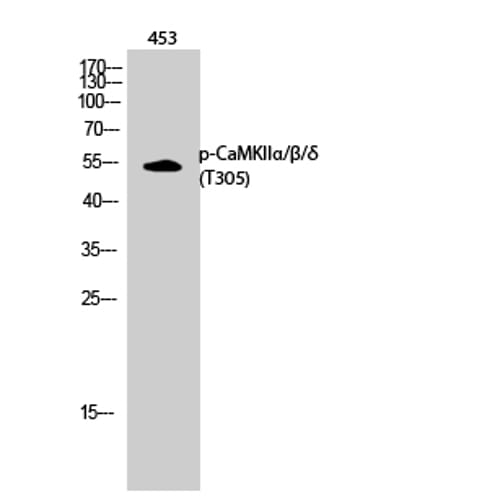
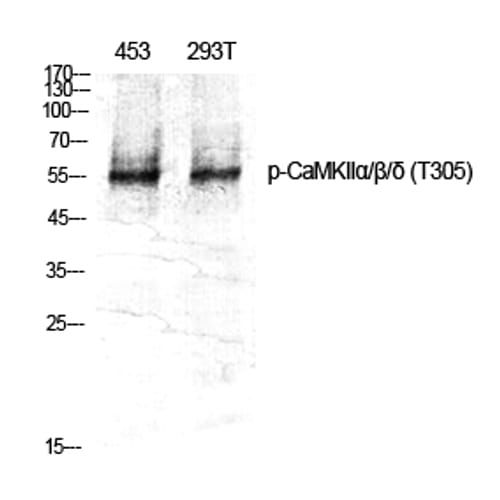
| Recommended Dilution | Western Blot: 1/500 - 1/2000. Immunohistochemistry: 1/100 - 1/300. ELISA: 1/5000. Not yet tested in other applications. |
| Concentration | 1 mg/ml |
| Reactive Species | Human,Mouse,Rat |
| Host Species | Rabbit |
| Immunogen | Synthesized phospho-peptide around the phosphorylation site of human CaMKIIα/β/δ (phospho Thr305) |
| Specificity | Phospho-CaMKIIα/β/δ (T305) Polyclonal Antibody detects endogenous levels of CaMKIIα/β/δ protein only when phosphorylated at T305. |
| Purification | The antibody was affinity-purified from rabbit antiserum by affinity-chromatography using epitope-specific immunogen |
| Form | Liquid in PBS containing 50% glycerol, 0.5% BSA and 0.02% sodium azide. |
| Gene Name | CAMK2A |
| Accession No. | Q9UQM7/Q13554/Q13557 P11275/P08413/P15791 |
| Alternate Names | CAMK2A; CAMKA; KIAA0968; Calcium/calmodulin-dependent protein kinase type II subunit alpha; CaM kinase II subunit alpha; CaMK-II subunit alpha; CAMK2B; CAM2; CAMK2; CAMKB; Calcium/calmodulin-dependent protein kinase type II subunit beta; Ca |
| Description | calcium/calmodulin dependent protein kinase II alpha(CAMK2A) Homo sapiens The product of this gene belongs to the serine/threonine protein kinases family, and to the Ca(2+)/calmodulin-dependent protein kinases subfamily. Calcium signaling is crucial for several aspects of plasticity at glutamatergic synapses. This calcium calmodulin-dependent protein kinase is composed of four different chains: alpha, beta, gamma, and delta. The alpha chain encoded by this gene is required for hippocampal long-term potentiation (LTP) and spatial learning. In addition to its calcium-calmodulin (CaM)-dependent activity, this protein can undergo autophosphorylation, resulting in CaM-independent activity. Two transcript variants encoding distinct isoforms have been identified for this gene. [provided by RefSeq, Nov 2008], |
| Cell Pathway/ Category | ErbB_HER,Calcium,Oocyte meiosis,WNT,WNT-T CELLLong-term potentiation,Neurotrophin,Olfactory transduction,GnRH,Melanogenesis,Glioma, |
| Protein Expression | Brain, |
| Subcellular Localization | nucleus,nucleoplasm,mitochondrion,cytosol,plasma membrane,postsynaptic density,cell junction,endocytic vesicle membrane,presynaptic membrane, |
| Protein Function | catalytic activity:ATP + a protein = ADP + a phosphoprotein.,enzyme regulation:Autophosphorylation of Thr-286 allows the kinase to switch from a calmodulin-dependent to a calmodulin-independent state.,function:CaM-kinase II (CAMK2) is a prominent kinase in the central nervous system that may function in long-term potentiation and neurotransmitter release. Member of the NMDAR signaling complex in excitatory synapses it may regulate NMDAR-dependent potentiation of the AMPAR and synaptic plasticity.,similarity:Belongs to the protein kinase superfamily.,similarity:Belongs to the protein kinase superfamily. CAMK Ser/Thr protein kinase family. CaMK subfamily.,similarity:Contains 1 protein kinase domain.,subcellular location:Postsynaptic lipid rafts.,subunit:CAMK2 is composed of four different chains: alpha, beta, gamma, and delta. The different isoforms assemble into homo- or heteromultimeric holoenzymes composed of 8 to 12 subunits. Interacts with BAALC, MPDZ, SYN1, CAMK2N2 and SYNGAP1., |
| Usage | For Research Use Only! Not for diagnostic or therapeutic procedures. |