

ITP0390
ITP0390
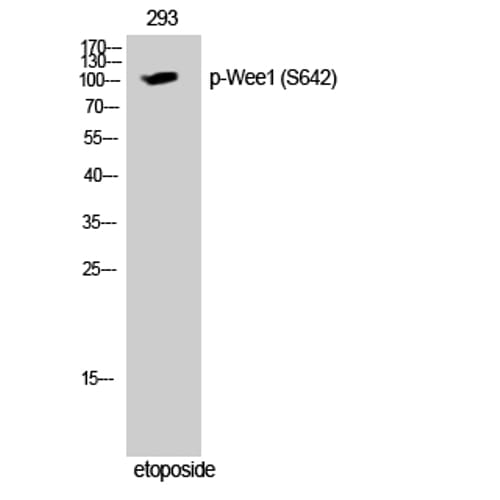
ITP0390
from
$541.00
Price in reward points: 541
- Catalog: ITP0390
- Gene/Protein: WEE1
- Product Description: Immunotag™ Wee1 (phospho Ser642) Polyclonal Antibody
-
Description
-
Specifications
Antibody Specification Datasheet 
IMPORTANT NOTE This product is custom manufactured with a lead time of 3-4 weeks. Once in production, this item cannot be cancelled from an order and is not eligible for return. Target Protein WEE1 (Ser642) Clonality Polyclonal Storage/Stability -20°C/1 year Application WB,ELISA Recommended Dilution Western Blot: 1/500 - 1/2000. ELISA: 1/5000. Not yet tested in other applications. Concentration 1 mg/ml Reactive Species Human,Mouse,Rat Host Species Rabbit Immunogen Synthesized phospho-peptide around the phosphorylation site of human Wee1 (phospho Ser642) Specificity Phospho-Wee1 (S642) Polyclonal Antibody detects endogenous levels of Wee1 protein only when phosphorylated at S642. Purification The antibody was affinity-purified from rabbit antiserum by affinity-chromatography using epitope-specific immunogen Form Liquid in PBS containing 50% glycerol, 0.5% BSA and 0.02% sodium azide. Gene Name WEE1 Accession No. P30291 P47810 Q63802 Alternate Names WEE1; Wee1-like protein kinase; WEE1hu; Wee1A kinase Description WEE1 G2 checkpoint kinase(WEE1) Homo sapiens This gene encodes a nuclear protein, which is a tyrosine kinase belonging to the Ser/Thr family of protein kinases. This protein catalyzes the inhibitory tyrosine phosphorylation of CDC2/cyclin B kinase, and appears to coordinate the transition between DNA replication and mitosis by protecting the nucleus from cytoplasmically activated CDC2 kinase. [provided by RefSeq, Jul 2008], Cell Pathway/ Category Cell_Cycle_G1S,Cell_Cycle_G2M_DNA, Protein Expression Amygdala,Blood,Epithelium,Human uterus endothel primary cell culture,Placenta,Skin, Subcellular Localization nucleus,nucleoplasm,nucleolus,cytoplasm, Protein Function catalytic activity:ATP + a [protein]-L-tyrosine = ADP + a [protein]-L-tyrosine phosphate.,cofactor:Binds 2 magnesium ions per subunit.,enzyme regulation:Synthesis is increased during S and G2 phases, presumably by an increase in transcription; activity is decreased by phosphorylation during m phase. Protein levels fall in M phase as a result of decreased synthesis combined with degradation. Activity seems to be negatively regulated by phosphorylation upon entry into mitosis, although N-terminal phosphorylation might also regulate the protein stability via protection from proteolysis or might regulate the subcellular location.,function:May act as a negative regulator of entry into mitosis (G2 to M transition) by protecting the nucleus from cytoplasmically activated cyclin B1-complexed CDC2 before the onset of mitosis. Its activity increases during S and G2 phases and decreases at M phase when it is hyperphosphorylated. A correlated decrease in protein level occurs at M/G1 phase, probably due to its degradation. Specifically phosphorylates and inactivates cyclin B1-complexed CDC2 reaching a maximum during G2 phase and a minimum as cells enter M phase. Phosphorylation of cyclin B1-CDC2 occurs exclusively on 'Tyr-15' and phosphorylation of monomeric CDC2 does not occur.,PTM:Phosphorylated during M and G1 phases. Also autophosphorylated.,PTM:Ubiquitinated and degraded at the onset of G2/M phase.,similarity:Belongs to the protein kinase superfamily.,similarity:Belongs to the protein kinase superfamily. Ser/Thr protein kinase family. WEE1 subfamily.,similarity:Contains 1 protein kinase domain., Usage For Research Use Only! Not for diagnostic or therapeutic procedures. - Reviews
| Antibody Specification | |
| Datasheet | |
| IMPORTANT NOTE | This product is custom manufactured with a lead time of 3-4 weeks. Once in production, this item cannot be cancelled from an order and is not eligible for return. |
| Target Protein | WEE1 (Ser642) |
| Clonality | Polyclonal |
| Storage/Stability | -20°C/1 year |
| Application | WB,ELISA |
| Recommended Dilution | Western Blot: 1/500 - 1/2000. ELISA: 1/5000. Not yet tested in other applications. |
| Concentration | 1 mg/ml |
| Reactive Species | Human,Mouse,Rat |
| Host Species | Rabbit |
| Immunogen | Synthesized phospho-peptide around the phosphorylation site of human Wee1 (phospho Ser642) |
| Specificity | Phospho-Wee1 (S642) Polyclonal Antibody detects endogenous levels of Wee1 protein only when phosphorylated at S642. |
| Purification | The antibody was affinity-purified from rabbit antiserum by affinity-chromatography using epitope-specific immunogen |
| Form | Liquid in PBS containing 50% glycerol, 0.5% BSA and 0.02% sodium azide. |
| Gene Name | WEE1 |
| Accession No. | P30291 P47810 Q63802 |
| Alternate Names | WEE1; Wee1-like protein kinase; WEE1hu; Wee1A kinase |
| Description | WEE1 G2 checkpoint kinase(WEE1) Homo sapiens This gene encodes a nuclear protein, which is a tyrosine kinase belonging to the Ser/Thr family of protein kinases. This protein catalyzes the inhibitory tyrosine phosphorylation of CDC2/cyclin B kinase, and appears to coordinate the transition between DNA replication and mitosis by protecting the nucleus from cytoplasmically activated CDC2 kinase. [provided by RefSeq, Jul 2008], |
| Cell Pathway/ Category | Cell_Cycle_G1S,Cell_Cycle_G2M_DNA, |
| Protein Expression | Amygdala,Blood,Epithelium,Human uterus endothel primary cell culture,Placenta,Skin, |
| Subcellular Localization | nucleus,nucleoplasm,nucleolus,cytoplasm, |
| Protein Function | catalytic activity:ATP + a [protein]-L-tyrosine = ADP + a [protein]-L-tyrosine phosphate.,cofactor:Binds 2 magnesium ions per subunit.,enzyme regulation:Synthesis is increased during S and G2 phases, presumably by an increase in transcription; activity is decreased by phosphorylation during m phase. Protein levels fall in M phase as a result of decreased synthesis combined with degradation. Activity seems to be negatively regulated by phosphorylation upon entry into mitosis, although N-terminal phosphorylation might also regulate the protein stability via protection from proteolysis or might regulate the subcellular location.,function:May act as a negative regulator of entry into mitosis (G2 to M transition) by protecting the nucleus from cytoplasmically activated cyclin B1-complexed CDC2 before the onset of mitosis. Its activity increases during S and G2 phases and decreases at M phase when it is hyperphosphorylated. A correlated decrease in protein level occurs at M/G1 phase, probably due to its degradation. Specifically phosphorylates and inactivates cyclin B1-complexed CDC2 reaching a maximum during G2 phase and a minimum as cells enter M phase. Phosphorylation of cyclin B1-CDC2 occurs exclusively on 'Tyr-15' and phosphorylation of monomeric CDC2 does not occur.,PTM:Phosphorylated during M and G1 phases. Also autophosphorylated.,PTM:Ubiquitinated and degraded at the onset of G2/M phase.,similarity:Belongs to the protein kinase superfamily.,similarity:Belongs to the protein kinase superfamily. Ser/Thr protein kinase family. WEE1 subfamily.,similarity:Contains 1 protein kinase domain., |
| Usage | For Research Use Only! Not for diagnostic or therapeutic procedures. |