

ITP0515
ITP0515
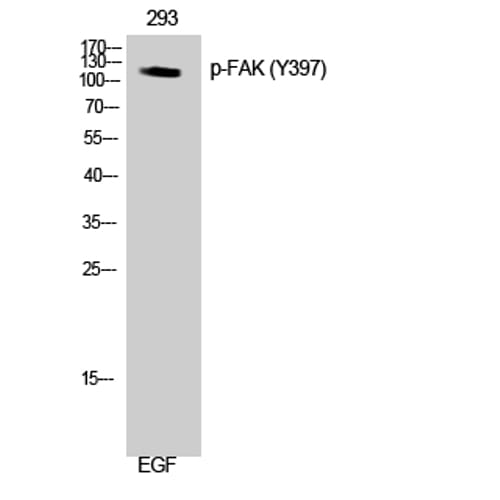
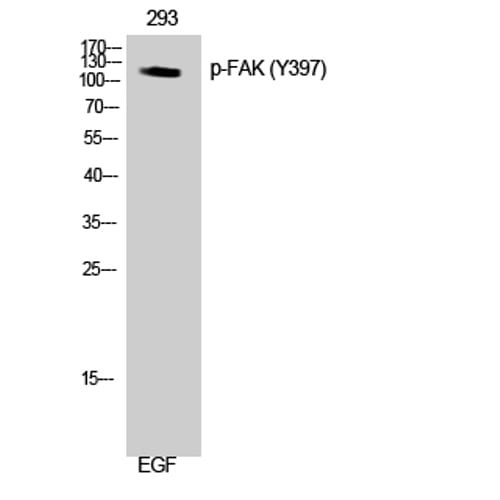
ITP0515
from
$541.00
Price in reward points: 541
- Catalog: ITP0515
- Gene/Protein: PTK2
- Product Description: Immunotag™ FAK (phospho Tyr397) Polyclonal Antibody
-
Description
-
Specifications
Antibody Specification Datasheet 
IMPORTANT NOTE This product is custom manufactured with a lead time of 3-4 weeks. Once in production, this item cannot be cancelled from an order and is not eligible for return. Target Protein FAK (Tyr397) Clonality Polyclonal Storage/Stability -20°C/1 year Application WB,ELISA Recommended Dilution Western Blot: 1/500 - 1/2000. ELISA: 1/5000. Not yet tested in other applications. Concentration 1 mg/ml Reactive Species Human,Mouse,Rat Host Species Rabbit Immunogen Synthesized phospho-peptide around the phosphorylation site of human FAK (phospho Tyr397) Specificity Phospho-FAK (Y397) Polyclonal Antibody detects endogenous levels of FAK protein only when phosphorylated at Y397. Purification The antibody was affinity-purified from rabbit antiserum by affinity-chromatography using epitope-specific immunogen Form Liquid in PBS containing 50% glycerol, 0.5% BSA and 0.02% sodium azide. Gene Name PTK2 Accession No. Q05397 P34152 O35346 Alternate Names PTK2; FAK; FAK1; Focal adhesion kinase 1; FADK 1; Focal adhesion kinase-related nonkinase; FRNK; Protein phosphatase 1 regulatory subunit 71; PPP1R71; Protein-tyrosine kinase 2; p125FAK; pp125FAK Description protein tyrosine kinase 2(PTK2) Homo sapiens This gene encodes a cytoplasmic protein tyrosine kinase which is found concentrated in the focal adhesions that form between cells growing in the presence of extracellular matrix constituents. The encoded protein is a member of the FAK subfamily of protein tyrosine kinases but lacks significant sequence similarity to kinases from other subfamilies. Activation of this gene may be an important early step in cell growth and intracellular signal transduction pathways triggered in response to certain neural peptides or to cell interactions with the extracellular matrix. Several transcript variants encoding different isoforms have been found for this gene, but the full-length natures of only four of them have been determined. [provided by RefSeq, Oct 2015], Cell Pathway/ Category ErbB_HER,Chemokine,Axon guidance,VEGF,Focal adhesion,Leukocyte transendothelial migration,Regulates Actin and Cytoskeleton,Pathways in cancer,Small cell lung cancer, Protein Expression Brain,Epithelium,Hippocampus,Melanocyte,Osteosarcoma,Placenta,Stomach,T-cell, Subcellular Localization stress fiber,nucleus,cytoplasm,microtubule organizing center,cytosol,cytoskeleton,plasma membrane,focal adhesion,cell cortex,apical plasma membrane,lamellipodium,extrinsic component of cytoplasmic side of plasma membrane, Protein Function catalytic activity:ATP + a [protein]-L-tyrosine = ADP + a [protein]-L-tyrosine phosphate.,domain:The carboxy-terminal region is the site of focal adhesion targeting (FAT) sequence which mediates the localization of FAK1 to focal adhesions.,domain:The first Pro-rich domain interacts with the SH3 domain of CRK-associated substrate (BCAR1) and CASL.,function:Non-receptor protein-tyrosine kinase implicated in signaling pathways involved in cell motility, proliferation and apoptosis. Activated by tyrosine-phosphorylation in response to either integrin clustering induced by cell adhesion or antibody cross-linking, or via G-protein coupled receptor (GPCR) occupancy by ligands such as bombesin or lysophosphatidic acid, or via LDL receptor occupancy. Plays a potential role in oncogenic transformations resulting in increased kinase activity.,PTM:Phosphorylated on 6 tyrosine residues upon activation.,similarity:Belongs to the protein kinase superfamily. Tyr protein kinase family.,similarity:Belongs to the protein kinase superfamily. Tyr protein kinase family. FAK subfamily.,similarity:Contains 1 FERM domain.,similarity:Contains 1 protein kinase domain.,subcellular location:Constituent of focal adhesions.,subunit:Interacts with CAS family members and with GIT1, SORBS1 and BCAR3. Interacts with RGNEF and SHB (By similarity). Interacts with TGFB1I1.,tissue specificity:Expressed in all organs tested, in lymphoid cell lines, but most abundantly in brain., Usage For Research Use Only! Not for diagnostic or therapeutic procedures. - Reviews
| Antibody Specification | |
| Datasheet | |
| IMPORTANT NOTE | This product is custom manufactured with a lead time of 3-4 weeks. Once in production, this item cannot be cancelled from an order and is not eligible for return. |
| Target Protein | FAK (Tyr397) |
| Clonality | Polyclonal |
| Storage/Stability | -20°C/1 year |
| Application | WB,ELISA |
| Recommended Dilution | Western Blot: 1/500 - 1/2000. ELISA: 1/5000. Not yet tested in other applications. |
| Concentration | 1 mg/ml |
| Reactive Species | Human,Mouse,Rat |
| Host Species | Rabbit |
| Immunogen | Synthesized phospho-peptide around the phosphorylation site of human FAK (phospho Tyr397) |
| Specificity | Phospho-FAK (Y397) Polyclonal Antibody detects endogenous levels of FAK protein only when phosphorylated at Y397. |
| Purification | The antibody was affinity-purified from rabbit antiserum by affinity-chromatography using epitope-specific immunogen |
| Form | Liquid in PBS containing 50% glycerol, 0.5% BSA and 0.02% sodium azide. |
| Gene Name | PTK2 |
| Accession No. | Q05397 P34152 O35346 |
| Alternate Names | PTK2; FAK; FAK1; Focal adhesion kinase 1; FADK 1; Focal adhesion kinase-related nonkinase; FRNK; Protein phosphatase 1 regulatory subunit 71; PPP1R71; Protein-tyrosine kinase 2; p125FAK; pp125FAK |
| Description | protein tyrosine kinase 2(PTK2) Homo sapiens This gene encodes a cytoplasmic protein tyrosine kinase which is found concentrated in the focal adhesions that form between cells growing in the presence of extracellular matrix constituents. The encoded protein is a member of the FAK subfamily of protein tyrosine kinases but lacks significant sequence similarity to kinases from other subfamilies. Activation of this gene may be an important early step in cell growth and intracellular signal transduction pathways triggered in response to certain neural peptides or to cell interactions with the extracellular matrix. Several transcript variants encoding different isoforms have been found for this gene, but the full-length natures of only four of them have been determined. [provided by RefSeq, Oct 2015], |
| Cell Pathway/ Category | ErbB_HER,Chemokine,Axon guidance,VEGF,Focal adhesion,Leukocyte transendothelial migration,Regulates Actin and Cytoskeleton,Pathways in cancer,Small cell lung cancer, |
| Protein Expression | Brain,Epithelium,Hippocampus,Melanocyte,Osteosarcoma,Placenta,Stomach,T-cell, |
| Subcellular Localization | stress fiber,nucleus,cytoplasm,microtubule organizing center,cytosol,cytoskeleton,plasma membrane,focal adhesion,cell cortex,apical plasma membrane,lamellipodium,extrinsic component of cytoplasmic side of plasma membrane, |
| Protein Function | catalytic activity:ATP + a [protein]-L-tyrosine = ADP + a [protein]-L-tyrosine phosphate.,domain:The carboxy-terminal region is the site of focal adhesion targeting (FAT) sequence which mediates the localization of FAK1 to focal adhesions.,domain:The first Pro-rich domain interacts with the SH3 domain of CRK-associated substrate (BCAR1) and CASL.,function:Non-receptor protein-tyrosine kinase implicated in signaling pathways involved in cell motility, proliferation and apoptosis. Activated by tyrosine-phosphorylation in response to either integrin clustering induced by cell adhesion or antibody cross-linking, or via G-protein coupled receptor (GPCR) occupancy by ligands such as bombesin or lysophosphatidic acid, or via LDL receptor occupancy. Plays a potential role in oncogenic transformations resulting in increased kinase activity.,PTM:Phosphorylated on 6 tyrosine residues upon activation.,similarity:Belongs to the protein kinase superfamily. Tyr protein kinase family.,similarity:Belongs to the protein kinase superfamily. Tyr protein kinase family. FAK subfamily.,similarity:Contains 1 FERM domain.,similarity:Contains 1 protein kinase domain.,subcellular location:Constituent of focal adhesions.,subunit:Interacts with CAS family members and with GIT1, SORBS1 and BCAR3. Interacts with RGNEF and SHB (By similarity). Interacts with TGFB1I1.,tissue specificity:Expressed in all organs tested, in lymphoid cell lines, but most abundantly in brain., |
| Usage | For Research Use Only! Not for diagnostic or therapeutic procedures. |