

ITP0581
ITP0581
ITP0581
from
$541.00
Price in reward points: 541
- Catalog: ITP0581
- Gene/Protein: PTPN11
- Product Description: Immunotag™ SH-PTP2 (phospho Tyr542) Polyclonal Antibody
-
Description
-
Specifications
Antibody Specification Datasheet 
IMPORTANT NOTE This product is custom manufactured with a lead time of 3-4 weeks. Once in production, this item cannot be cancelled from an order and is not eligible for return. Target Protein SH-PTP2 (Tyr542) Clonality Polyclonal Storage/Stability -20°C/1 year Application WB,IHC-p,ELISA Recommended Dilution Western Blot: 1/500 - 1/2000. Immunohistochemistry: 1/100 - 1/300. ELISA: 1/40000. Not yet tested in other applications. Concentration 1 mg/ml Reactive Species Human,Mouse,Rat Host Species Rabbit Immunogen Synthesized phospho-peptide around the phosphorylation site of human SH-PTP2 (phospho Tyr542) Specificity Phospho-SH-PTP2 (Y542) Polyclonal Antibody detects endogenous levels of SH-PTP2 protein only when phosphorylated at Y542. Purification The antibody was affinity-purified from rabbit antiserum by affinity-chromatography using epitope-specific immunogen Form Liquid in PBS containing 50% glycerol, 0.5% BSA and 0.02% sodium azide. Gene Name PTPN11 Accession No. Q06124 P35235 P41499 Alternate Names PTPN11; PTP2C; SHPTP2; Tyrosine-protein phosphatase non-receptor type 11; Protein-tyrosine phosphatase 1D; PTP-1D; Protein-tyrosine phosphatase 2C; PTP-2C; SH-PTP2; SHP-2; Shp2; SH-PTP3 Description protein tyrosine phosphatase, non-receptor type 11(PTPN11) Homo sapiens The protein encoded by this gene is a member of the protein tyrosine phosphatase (PTP) family. PTPs are known to be signaling molecules that regulate a variety of cellular processes including cell growth, differentiation, mitotic cycle, and oncogenic transformation. This PTP contains two tandem Src homology-2 domains, which function as phospho-tyrosine binding domains and mediate the interaction of this PTP with its substrates. This PTP is widely expressed in most tissues and plays a regulatory role in various cell signaling events that are important for a diversity of cell functions, such as mitogenic activation, metabolic control, transcription regulation, and cell migration. Mutations in this gene are a cause of Noonan syndrome as well as acute myeloid leukemia. [provided by RefSeq, Aug 2016], Cell Pathway/ Category Insulin Receptor, B Cell Receptor, MAPK, Protein_Acetylation Protein Expression Alzheimer cortex,Cervix,Epithelium,Eye,T-cell,Testi Subcellular Localization nucleus,cytoplasm,mitochondrion,cytosol,protein complex, Protein Function catalytic activity:Protein tyrosine phosphate + H(2)O = protein tyrosine + phosphate.,disease:Defects in PTPN11 are a cause of juvenile myelomonocytic leukemia (JMML) [MIM:607785]. JMML is a pediatric myelodysplastic syndrome that constitutes approximately 30% of childhood cases of myelodysplastic syndrome (MDS) and 2% of leukemia. It is characterized by leukocytosis with tissue infiltration and in vitro hypersensitivity of myeloid progenitors to granulocyte-macrophage colony stimulating factor.,disease:Defects in PTPN11 are a cause of Noonan-like syndrome [MIM:163955]; also known as Noonan-like/multiple giant cell lesion syndrome. It is an autosomal dominant disorder characterized by Noonan features associates with giant cell lesions of bone and soft tissue.,disease:Defects in PTPN11 are the cause of LEOPARD syndrome [MIM:151100]. It is an autosomal dominant disorder allelic with Noonan syndrome. The acronym LEOPARD stands for lentigines, electrocardiographic conduction abnormalities, ocular hypertelorism, pulmonic stenosis, abnormalities of genitalia, retardation of growth, and deafness.,disease:Defects in PTPN11 are the cause of Noonan syndrome 1 (NS1) [MIM:163950]. Noonan syndrome (NS) is a disorder characterized by dysmorphic facial features, short stature, hypertelorism, cardiac anomalies, deafness, motor delay, and a bleeding diathesis. It is a genetically heterogeneous and relatively common syndrome, with an estimated incidence of 1 in 1000-2500 live births. Mutations in PTPN11 account for more than 50% of the cases. Rarely, NS is associated with juvenile myelomonocytic leukemia (JMML). NS1 inheritance is autosomal dominant.,domain:The SH2 domains repress phosphatase activity. Binding of these domains to phosphotyrosine-containing proteins relieves this auto-inhibition, possibly by inducing a conformational change in the enzyme.,function:Acts downstream of various receptor and cytoplasmic protein tyrosine kinases to participate in the signal transduction from the cell surface to the nucleus.,PTM:Phosphorylated on Tyr-546 and Tyr-584 upon receptor protein tyrosine kinase activation; which creates a binding site for GRB2 and other SH2-containing proteins.,similarity:Belongs to the protein-tyrosine phosphatase family. Non-receptor class 2 subfamily.,similarity:Contains 1 tyrosine-protein phosphatase domain.,similarity:Contains 2 SH2 domains.,subunit:Interacts with phosphorylated LIME1 and BCAR3. Interacts with SHB and INPP5D/SHIP1 (By similarity). Interacts with PTPNS1 and CD84. Interacts with phosphorylated SIT1 and MPZL1. Interacts with FCRL3, FCRL4, FCRL6 and ANKHD1.,tissue specificity:Widely expressed, with highest levels in heart, brain, and skeletal muscle., Usage For Research Use Only! Not for diagnostic or therapeutic procedures. - Reviews
| Antibody Specification | |
| Datasheet | |
| IMPORTANT NOTE | This product is custom manufactured with a lead time of 3-4 weeks. Once in production, this item cannot be cancelled from an order and is not eligible for return. |
| Target Protein | SH-PTP2 (Tyr542) |
| Clonality | Polyclonal |
| Storage/Stability | -20°C/1 year |
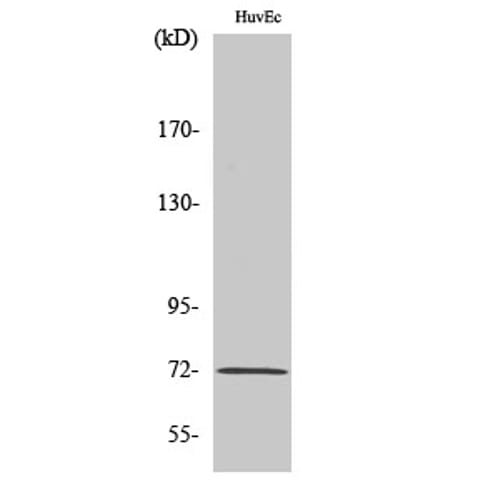
| Application | WB,IHC-p,ELISA |
| Recommended Dilution | Western Blot: 1/500 - 1/2000. Immunohistochemistry: 1/100 - 1/300. ELISA: 1/40000. Not yet tested in other applications. |
| Concentration | 1 mg/ml |
| Reactive Species | Human,Mouse,Rat |
| Host Species | Rabbit |
| Immunogen | Synthesized phospho-peptide around the phosphorylation site of human SH-PTP2 (phospho Tyr542) |
| Specificity | Phospho-SH-PTP2 (Y542) Polyclonal Antibody detects endogenous levels of SH-PTP2 protein only when phosphorylated at Y542. |
| Purification | The antibody was affinity-purified from rabbit antiserum by affinity-chromatography using epitope-specific immunogen |
| Form | Liquid in PBS containing 50% glycerol, 0.5% BSA and 0.02% sodium azide. |
| Gene Name | PTPN11 |
| Accession No. | Q06124 P35235 P41499 |
| Alternate Names | PTPN11; PTP2C; SHPTP2; Tyrosine-protein phosphatase non-receptor type 11; Protein-tyrosine phosphatase 1D; PTP-1D; Protein-tyrosine phosphatase 2C; PTP-2C; SH-PTP2; SHP-2; Shp2; SH-PTP3 |
| Description | protein tyrosine phosphatase, non-receptor type 11(PTPN11) Homo sapiens The protein encoded by this gene is a member of the protein tyrosine phosphatase (PTP) family. PTPs are known to be signaling molecules that regulate a variety of cellular processes including cell growth, differentiation, mitotic cycle, and oncogenic transformation. This PTP contains two tandem Src homology-2 domains, which function as phospho-tyrosine binding domains and mediate the interaction of this PTP with its substrates. This PTP is widely expressed in most tissues and plays a regulatory role in various cell signaling events that are important for a diversity of cell functions, such as mitogenic activation, metabolic control, transcription regulation, and cell migration. Mutations in this gene are a cause of Noonan syndrome as well as acute myeloid leukemia. [provided by RefSeq, Aug 2016], |
| Cell Pathway/ Category | Insulin Receptor, B Cell Receptor, MAPK, Protein_Acetylation |
| Protein Expression | Alzheimer cortex,Cervix,Epithelium,Eye,T-cell,Testi |
| Subcellular Localization | nucleus,cytoplasm,mitochondrion,cytosol,protein complex, |
| Protein Function | catalytic activity:Protein tyrosine phosphate + H(2)O = protein tyrosine + phosphate.,disease:Defects in PTPN11 are a cause of juvenile myelomonocytic leukemia (JMML) [MIM:607785]. JMML is a pediatric myelodysplastic syndrome that constitutes approximately 30% of childhood cases of myelodysplastic syndrome (MDS) and 2% of leukemia. It is characterized by leukocytosis with tissue infiltration and in vitro hypersensitivity of myeloid progenitors to granulocyte-macrophage colony stimulating factor.,disease:Defects in PTPN11 are a cause of Noonan-like syndrome [MIM:163955]; also known as Noonan-like/multiple giant cell lesion syndrome. It is an autosomal dominant disorder characterized by Noonan features associates with giant cell lesions of bone and soft tissue.,disease:Defects in PTPN11 are the cause of LEOPARD syndrome [MIM:151100]. It is an autosomal dominant disorder allelic with Noonan syndrome. The acronym LEOPARD stands for lentigines, electrocardiographic conduction abnormalities, ocular hypertelorism, pulmonic stenosis, abnormalities of genitalia, retardation of growth, and deafness.,disease:Defects in PTPN11 are the cause of Noonan syndrome 1 (NS1) [MIM:163950]. Noonan syndrome (NS) is a disorder characterized by dysmorphic facial features, short stature, hypertelorism, cardiac anomalies, deafness, motor delay, and a bleeding diathesis. It is a genetically heterogeneous and relatively common syndrome, with an estimated incidence of 1 in 1000-2500 live births. Mutations in PTPN11 account for more than 50% of the cases. Rarely, NS is associated with juvenile myelomonocytic leukemia (JMML). NS1 inheritance is autosomal dominant.,domain:The SH2 domains repress phosphatase activity. Binding of these domains to phosphotyrosine-containing proteins relieves this auto-inhibition, possibly by inducing a conformational change in the enzyme.,function:Acts downstream of various receptor and cytoplasmic protein tyrosine kinases to participate in the signal transduction from the cell surface to the nucleus.,PTM:Phosphorylated on Tyr-546 and Tyr-584 upon receptor protein tyrosine kinase activation; which creates a binding site for GRB2 and other SH2-containing proteins.,similarity:Belongs to the protein-tyrosine phosphatase family. Non-receptor class 2 subfamily.,similarity:Contains 1 tyrosine-protein phosphatase domain.,similarity:Contains 2 SH2 domains.,subunit:Interacts with phosphorylated LIME1 and BCAR3. Interacts with SHB and INPP5D/SHIP1 (By similarity). Interacts with PTPNS1 and CD84. Interacts with phosphorylated SIT1 and MPZL1. Interacts with FCRL3, FCRL4, FCRL6 and ANKHD1.,tissue specificity:Widely expressed, with highest levels in heart, brain, and skeletal muscle., |
| Usage | For Research Use Only! Not for diagnostic or therapeutic procedures. |