

ITP0756
ITP0756
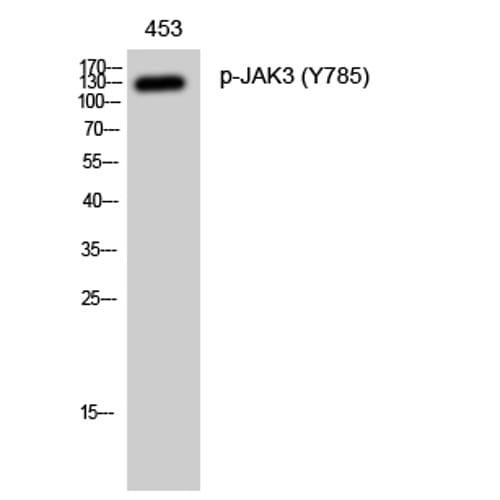
ITP0756
from
$541.00
Price in reward points: 541
- Catalog: ITP0756
- Gene/Protein: JAK3
- Product Description: Immunotag™ JAK3 (phospho Tyr785) Polyclonal Antibody
-
Description
-
Specifications
Antibody Specification Datasheet 
IMPORTANT NOTE This product is custom manufactured with a lead time of 3-4 weeks. Once in production, this item cannot be cancelled from an order and is not eligible for return. Target Protein JAK3 (Tyr79000) Clonality Polyclonal Storage/Stability -20°C/1 year Application WB,IHC-p,ELISA Recommended Dilution Western Blot: 1/500 - 1/2000. Immunohistochemistry: 1/100 - 1/300. ELISA: 1/5000. Not yet tested in other applications. Concentration 1 mg/ml Reactive Species Human,Mouse,Rat Host Species Rabbit Immunogen Synthesized phospho-peptide around the phosphorylation site of human JAK3 (phospho Tyr785) Specificity Phospho-JAK3 (Y785) Polyclonal Antibody detects endogenous levels of JAK3 protein only when phosphorylated at Y785. Purification The antibody was affinity-purified from rabbit antiserum by affinity-chromatography using epitope-specific immunogen Form Liquid in PBS containing 50% glycerol, 0.5% BSA and 0.02% sodium azide. Gene Name JAK3 Accession No. P52333 Q62137 Q63272 Alternate Names JAK3; Tyrosine-protein kinase JAK3; Janus kinase 3; JAK-3; Leukocyte janus kinase; L-JAK Description Janus kinase 3(JAK3) Homo sapiens The protein encoded by this gene is a member of the Janus kinase (JAK) family of tyrosine kinases involved in cytokine receptor-mediated intracellular signal transduction. It is predominantly expressed in immune cells and transduces a signal in response to its activation via tyrosine phosphorylation by interleukin receptors. Mutations in this gene are associated with autosomal SCID (severe combined immunodeficiency disease). [provided by RefSeq, Jul 2008], Cell Pathway/ Category Chemokine,Jak_STAT,Primary immunodeficiency, Protein Expression Blood,Fetal brain,Spleen, Subcellular Localization cytosol,cytoskeleton,endomembrane system,membrane,extrinsic component of cytoplasmic side of plasma membrane, Protein Function catalytic activity:ATP + a [protein]-L-tyrosine = ADP + a [protein]-L-tyrosine phosphate.,disease:Defects in JAK3 are a cause of severe combined immunodeficiency autosomal recessive T-cell-negative/B-cell-positive/NK-cell-negative (T(-)B(+)NK(-)SCID) [MIM:600802]. SCID refers to a genetically and clinically heterogeneous group of rare congenital disorders characterized by impairment of both humoral and cell-mediated immunity, leukopenia, and low or absent antibody levels. Patients with SCID present in infancy with recurrent, persistent infections by opportunistic organisms. The common characteristic of all types of SCID is absence of T-cell-mediated cellular immunity due to a defect in T-cell development.,domain:Possesses two phosphotransferase domains. The second one probably contains the catalytic domain (By similarity), while the presence of slight differences suggest a different role for domain 1.,function:Tyrosine kinase of the non-receptor type, involved in the interleukin-2 and interleukin-4 signaling pathway. Phosphorylates STAT6, IRS1, IRS2 and PI3K.,online information:JAK3 mutation db,PTM:Tyrosine phosphorylated in response to IL-2 and IL-4.,similarity:Belongs to the protein kinase superfamily. Tyr protein kinase family. JAK subfamily.,similarity:Contains 1 FERM domain.,similarity:Contains 1 protein kinase domain.,similarity:Contains 1 SH2 domain.,subcellular location:Wholly intracellular, possibly membrane associated.,subunit:Interacts with STAM2 and MYO18A (By similarity). Interacts with SHB.,tissue specificity:In NK cells and an NK-like cell line but not in resting T-cells or in other tissues. The S-form is more commonly seen in hematopoietic lines, whereas the B- and M-forms are detected in cells both of hematopoietic and epithelial origins., Usage For Research Use Only! Not for diagnostic or therapeutic procedures. - Reviews
| Antibody Specification | |
| Datasheet | |
| IMPORTANT NOTE | This product is custom manufactured with a lead time of 3-4 weeks. Once in production, this item cannot be cancelled from an order and is not eligible for return. |
| Target Protein | JAK3 (Tyr79000) |
| Clonality | Polyclonal |
| Storage/Stability | -20°C/1 year |
| Application | WB,IHC-p,ELISA |
| Recommended Dilution | Western Blot: 1/500 - 1/2000. Immunohistochemistry: 1/100 - 1/300. ELISA: 1/5000. Not yet tested in other applications. |
| Concentration | 1 mg/ml |
| Reactive Species | Human,Mouse,Rat |
| Host Species | Rabbit |
| Immunogen | Synthesized phospho-peptide around the phosphorylation site of human JAK3 (phospho Tyr785) |
| Specificity | Phospho-JAK3 (Y785) Polyclonal Antibody detects endogenous levels of JAK3 protein only when phosphorylated at Y785. |
| Purification | The antibody was affinity-purified from rabbit antiserum by affinity-chromatography using epitope-specific immunogen |
| Form | Liquid in PBS containing 50% glycerol, 0.5% BSA and 0.02% sodium azide. |
| Gene Name | JAK3 |
| Accession No. | P52333 Q62137 Q63272 |
| Alternate Names | JAK3; Tyrosine-protein kinase JAK3; Janus kinase 3; JAK-3; Leukocyte janus kinase; L-JAK |
| Description | Janus kinase 3(JAK3) Homo sapiens The protein encoded by this gene is a member of the Janus kinase (JAK) family of tyrosine kinases involved in cytokine receptor-mediated intracellular signal transduction. It is predominantly expressed in immune cells and transduces a signal in response to its activation via tyrosine phosphorylation by interleukin receptors. Mutations in this gene are associated with autosomal SCID (severe combined immunodeficiency disease). [provided by RefSeq, Jul 2008], |
| Cell Pathway/ Category | Chemokine,Jak_STAT,Primary immunodeficiency, |
| Protein Expression | Blood,Fetal brain,Spleen, |
| Subcellular Localization | cytosol,cytoskeleton,endomembrane system,membrane,extrinsic component of cytoplasmic side of plasma membrane, |
| Protein Function | catalytic activity:ATP + a [protein]-L-tyrosine = ADP + a [protein]-L-tyrosine phosphate.,disease:Defects in JAK3 are a cause of severe combined immunodeficiency autosomal recessive T-cell-negative/B-cell-positive/NK-cell-negative (T(-)B(+)NK(-)SCID) [MIM:600802]. SCID refers to a genetically and clinically heterogeneous group of rare congenital disorders characterized by impairment of both humoral and cell-mediated immunity, leukopenia, and low or absent antibody levels. Patients with SCID present in infancy with recurrent, persistent infections by opportunistic organisms. The common characteristic of all types of SCID is absence of T-cell-mediated cellular immunity due to a defect in T-cell development.,domain:Possesses two phosphotransferase domains. The second one probably contains the catalytic domain (By similarity), while the presence of slight differences suggest a different role for domain 1.,function:Tyrosine kinase of the non-receptor type, involved in the interleukin-2 and interleukin-4 signaling pathway. Phosphorylates STAT6, IRS1, IRS2 and PI3K.,online information:JAK3 mutation db,PTM:Tyrosine phosphorylated in response to IL-2 and IL-4.,similarity:Belongs to the protein kinase superfamily. Tyr protein kinase family. JAK subfamily.,similarity:Contains 1 FERM domain.,similarity:Contains 1 protein kinase domain.,similarity:Contains 1 SH2 domain.,subcellular location:Wholly intracellular, possibly membrane associated.,subunit:Interacts with STAM2 and MYO18A (By similarity). Interacts with SHB.,tissue specificity:In NK cells and an NK-like cell line but not in resting T-cells or in other tissues. The S-form is more commonly seen in hematopoietic lines, whereas the B- and M-forms are detected in cells both of hematopoietic and epithelial origins., |
| Usage | For Research Use Only! Not for diagnostic or therapeutic procedures. |