

ITP0806
ITP0806
ITP0806
from
$541.00
Price in reward points: 541
- Catalog: ITP0806
- Gene/Protein: DDR1
- Product Description: Immunotag™ DDR1 (phospho Tyr513) Polyclonal Antibody
-
Description
-
Specifications
Antibody Specification Datasheet 
IMPORTANT NOTE This product is custom manufactured with a lead time of 3-4 weeks. Once in production, this item cannot be cancelled from an order and is not eligible for return. Target Protein DDR1 (Tyr513) Clonality Polyclonal Storage/Stability -20°C/1 year Application WB,IHC-p,ELISA Recommended Dilution Western Blot: 1/500 - 1/2000. Immunohistochemistry: 1/100 - 1/300. ELISA: 1/10000. Not yet tested in other applications. Concentration 1 mg/ml Reactive Species Human,Mouse,Rat Host Species Rabbit Immunogen Synthesized phospho-peptide around the phosphorylation site of human DDR1 (phospho Tyr513) Specificity Phospho-DDR1 (Y513) Polyclonal Antibody detects endogenous levels of DDR1 protein only when phosphorylated at Y513. Purification The antibody was affinity-purified from rabbit antiserum by affinity-chromatography using epitope-specific immunogen Form Liquid in PBS containing 50% glycerol, 0.5% BSA and 0.02% sodium azide. Gene Name DDR1 Accession No. Q08345 Q03146 Q63474 Alternate Names DDR1; CAK; EDDR1; NEP; NTRK4; PTK3A; RTK6; TRKE; Epithelial discoidin domain-containing receptor 1; Epithelial discoidin domain receptor 1; CD167 antigen-like family member A; Cell adhesion kinase; Discoidin receptor tyrosine kinase; HGK2; Description discoidin domain receptor tyrosine kinase 1(DDR1) Homo sapiens Receptor tyrosine kinases play a key role in the communication of cells with their microenvironment. These kinases are involved in the regulation of cell growth, differentiation and metabolism. The protein encoded by this gene belongs to a subfamily of tyrosine kinase receptors with homology to Dictyostelium discoideum protein discoidin I in their extracellular domain, and that are activated by various types of collagen. Expression of this protein is restricted to epithelial cells, particularly in the kidney, lung, gastrointestinal tract, and brain. In addition, it has been shown to be significantly overexpressed in several human tumors. Alternatively spliced transcript variants encoding different isoforms have been described for this gene. [provided by RefSeq, Feb 2011], Protein Expression Brain,Fetal liver,Keratinocyte,Lung,Muscle,Ovary,Peripheral Subcellular Localization extracellular space,plasma membrane,integral component of plasma membrane,membrane,integral component of membrane,receptor complex,extracellular exosome, Protein Function catalytic activity:ATP + a [protein]-L-tyrosine = ADP + a [protein]-L-tyrosine phosphate.,domain:The Gly/Pro-rich domains may be required for an unusual geometry of interaction with ligand or substrates.,function:May be involved in cell-cell interactions and recognition.,similarity:Belongs to the protein kinase superfamily. Tyr protein kinase family. Insulin receptor subfamily.,similarity:Contains 1 F5/8 type C domain.,similarity:Contains 1 protein kinase domain.,tissue specificity:Expressed at low levels in most adult tissues and is highest in the brain and lung. Abundant in breast carcinoma cell lines., Usage For Research Use Only! Not for diagnostic or therapeutic procedures. - Reviews
| Antibody Specification | |
| Datasheet | |
| IMPORTANT NOTE | This product is custom manufactured with a lead time of 3-4 weeks. Once in production, this item cannot be cancelled from an order and is not eligible for return. |
| Target Protein | DDR1 (Tyr513) |
| Clonality | Polyclonal |
| Storage/Stability | -20°C/1 year |
| Application | WB,IHC-p,ELISA |
| Recommended Dilution | Western Blot: 1/500 - 1/2000. Immunohistochemistry: 1/100 - 1/300. ELISA: 1/10000. Not yet tested in other applications. |
| Concentration | 1 mg/ml |
| Reactive Species | Human,Mouse,Rat |
| Host Species | Rabbit |
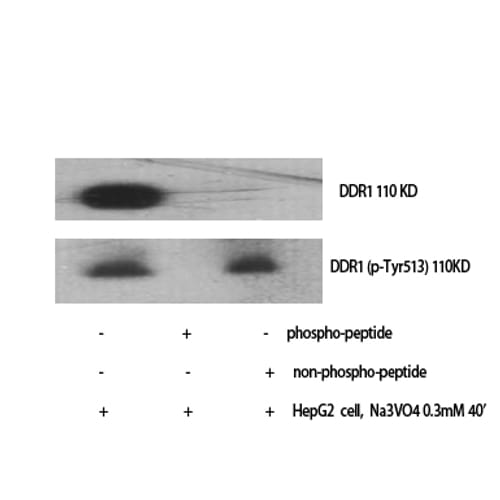
| Immunogen | Synthesized phospho-peptide around the phosphorylation site of human DDR1 (phospho Tyr513) |
| Specificity | Phospho-DDR1 (Y513) Polyclonal Antibody detects endogenous levels of DDR1 protein only when phosphorylated at Y513. |
| Purification | The antibody was affinity-purified from rabbit antiserum by affinity-chromatography using epitope-specific immunogen |
| Form | Liquid in PBS containing 50% glycerol, 0.5% BSA and 0.02% sodium azide. |
| Gene Name | DDR1 |
| Accession No. | Q08345 Q03146 Q63474 |
| Alternate Names | DDR1; CAK; EDDR1; NEP; NTRK4; PTK3A; RTK6; TRKE; Epithelial discoidin domain-containing receptor 1; Epithelial discoidin domain receptor 1; CD167 antigen-like family member A; Cell adhesion kinase; Discoidin receptor tyrosine kinase; HGK2; |
| Description | discoidin domain receptor tyrosine kinase 1(DDR1) Homo sapiens Receptor tyrosine kinases play a key role in the communication of cells with their microenvironment. These kinases are involved in the regulation of cell growth, differentiation and metabolism. The protein encoded by this gene belongs to a subfamily of tyrosine kinase receptors with homology to Dictyostelium discoideum protein discoidin I in their extracellular domain, and that are activated by various types of collagen. Expression of this protein is restricted to epithelial cells, particularly in the kidney, lung, gastrointestinal tract, and brain. In addition, it has been shown to be significantly overexpressed in several human tumors. Alternatively spliced transcript variants encoding different isoforms have been described for this gene. [provided by RefSeq, Feb 2011], |
| Protein Expression | Brain,Fetal liver,Keratinocyte,Lung,Muscle,Ovary,Peripheral |
| Subcellular Localization | extracellular space,plasma membrane,integral component of plasma membrane,membrane,integral component of membrane,receptor complex,extracellular exosome, |
| Protein Function | catalytic activity:ATP + a [protein]-L-tyrosine = ADP + a [protein]-L-tyrosine phosphate.,domain:The Gly/Pro-rich domains may be required for an unusual geometry of interaction with ligand or substrates.,function:May be involved in cell-cell interactions and recognition.,similarity:Belongs to the protein kinase superfamily. Tyr protein kinase family. Insulin receptor subfamily.,similarity:Contains 1 F5/8 type C domain.,similarity:Contains 1 protein kinase domain.,tissue specificity:Expressed at low levels in most adult tissues and is highest in the brain and lung. Abundant in breast carcinoma cell lines., |
| Usage | For Research Use Only! Not for diagnostic or therapeutic procedures. |