

ITP0815
ITP0815
ITP0815
from
$541.00
Price in reward points: 541
- Catalog: ITP0815
- Gene/Protein: CTBP1
- Product Description: Immunotag™ CtBP1 (phospho Ser422) Polyclonal Antibody
-
Description
-
Specifications
Antibody Specification Datasheet 
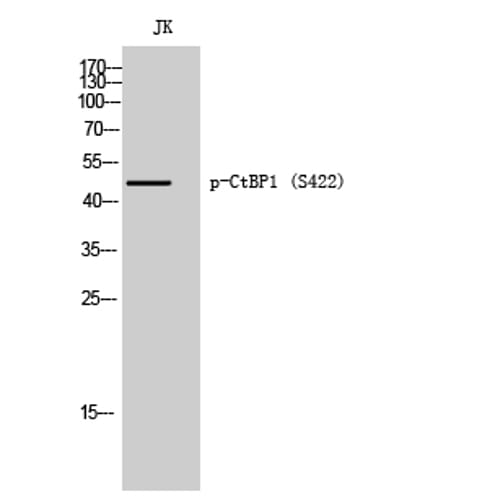
IMPORTANT NOTE This product is custom manufactured with a lead time of 3-4 weeks. Once in production, this item cannot be cancelled from an order and is not eligible for return. Target Protein CtBP1 (Ser422) Clonality Polyclonal Storage/Stability -20°C/1 year Application WB,IHC-p,ELISA Recommended Dilution Western Blot: 1/500 - 1/2000. Immunohistochemistry: 1/100 - 1/300. ELISA: 1/10000. Not yet tested in other applications. Concentration 1 mg/ml Reactive Species Human,Mouse,Rat Host Species Rabbit Immunogen The antiserum was produced against synthesized peptide derived from human CtBP1 around the phosphorylation site of Ser422. AA range:388-437 Specificity Phospho-CtBP1 (S422) Polyclonal Antibody detects endogenous levels of CtBP1 protein only when phosphorylated at S422. Purification The antibody was affinity-purified from rabbit antiserum by affinity-chromatography using epitope-specific immunogen Form Liquid in PBS containing 50% glycerol, 0.5% BSA and 0.02% sodium azide. Gene Name CTBP1 Accession No. Q13363 O88712 Q9Z2F5 Alternate Names CTBP1; CTBP; C-terminal-binding protein 1; CtBP1 Description C-terminal binding protein 1(CTBP1) Homo sapiens This gene encodes a protein that binds to the C-terminus of adenovirus E1A proteins. This phosphoprotein is a transcriptional repressor and may play a role during cellular proliferation. This protein and the product of a second closely related gene, CTBP2, can dimerize. Both proteins can also interact with a polycomb group protein complex which participates in regulation of gene expression during development. Alternative splicing of transcripts from this gene results in multiple transcript variants. [provided by RefSeq, Jul 2008], Cell Pathway/ Category WNT,WNT-T CELLNotch,Pathways in cancer,Chronic myeloid leukemia, Protein Expression B-cell,Brain,Cervix carcinoma,Lung,Placenta,Testis, Subcellular Localization nucleus,nucleoplasm,transcription factor complex,cytoplasm,transcriptional repressor complex, Protein Function cofactor:NAD. Required for efficient interaction with E1A. Cofactor binding induces a conformation change.,function:Involved in controlling the equilibrium between tubular and stacked structures in the Golgi complex (By similarity). Co-repressor targeting diverse transcription regulators such as GLIS2. Has dehydrogenase activity.,PTM:ADP-ribosylated; when cells are exposed to brefeldin-A (BFA).,PTM:Sumoylation on Lys-428 is promoted by the E3 SUMO-protein ligase CBX4.,PTM:The level of phosphorylation appears to be regulated during the cell cycle. Phosphorylated upon DNA damage, probably by ATM or ATR. Phosphorylation by HIPK2 on Ser-422 induces proteasomal degradation.,similarity:Belongs to the D-isomer specific 2-hydroxyacid dehydrogenase family.,subunit:Interacts with the C-terminus of adenovirus E1A protein, ELK3 and CTIP via their consensus motif P-X-[DNS]-L-[STVA]. Can form homodimers or heterodimers of CTBP1 and CTBP2. Interacts with FOXP2, HDAC4, HDAC5 and HDAC9. Interacts with GLIS2 but not GLIS1 or GLIS3 (By similarity). Interacts with FOXP1, HIPK2, PNN and NRIP1. Interacts with ZFHX1B and WIZ. Interacts with Epstein-Barr virus EBNA3 and EBNA6., Usage For Research Use Only! Not for diagnostic or therapeutic procedures. - Reviews
| Antibody Specification | |
| Datasheet | |
| IMPORTANT NOTE | This product is custom manufactured with a lead time of 3-4 weeks. Once in production, this item cannot be cancelled from an order and is not eligible for return. |
| Target Protein | CtBP1 (Ser422) |
| Clonality | Polyclonal |
| Storage/Stability | -20°C/1 year |
| Application | WB,IHC-p,ELISA |
| Recommended Dilution | Western Blot: 1/500 - 1/2000. Immunohistochemistry: 1/100 - 1/300. ELISA: 1/10000. Not yet tested in other applications. |
| Concentration | 1 mg/ml |
| Reactive Species | Human,Mouse,Rat |
| Host Species | Rabbit |
| Immunogen | The antiserum was produced against synthesized peptide derived from human CtBP1 around the phosphorylation site of Ser422. AA range:388-437 |
| Specificity | Phospho-CtBP1 (S422) Polyclonal Antibody detects endogenous levels of CtBP1 protein only when phosphorylated at S422. |
| Purification | The antibody was affinity-purified from rabbit antiserum by affinity-chromatography using epitope-specific immunogen |
| Form | Liquid in PBS containing 50% glycerol, 0.5% BSA and 0.02% sodium azide. |
| Gene Name | CTBP1 |
| Accession No. | Q13363 O88712 Q9Z2F5 |
| Alternate Names | CTBP1; CTBP; C-terminal-binding protein 1; CtBP1 |
| Description | C-terminal binding protein 1(CTBP1) Homo sapiens This gene encodes a protein that binds to the C-terminus of adenovirus E1A proteins. This phosphoprotein is a transcriptional repressor and may play a role during cellular proliferation. This protein and the product of a second closely related gene, CTBP2, can dimerize. Both proteins can also interact with a polycomb group protein complex which participates in regulation of gene expression during development. Alternative splicing of transcripts from this gene results in multiple transcript variants. [provided by RefSeq, Jul 2008], |
| Cell Pathway/ Category | WNT,WNT-T CELLNotch,Pathways in cancer,Chronic myeloid leukemia, |
| Protein Expression | B-cell,Brain,Cervix carcinoma,Lung,Placenta,Testis, |
| Subcellular Localization | nucleus,nucleoplasm,transcription factor complex,cytoplasm,transcriptional repressor complex, |
| Protein Function | cofactor:NAD. Required for efficient interaction with E1A. Cofactor binding induces a conformation change.,function:Involved in controlling the equilibrium between tubular and stacked structures in the Golgi complex (By similarity). Co-repressor targeting diverse transcription regulators such as GLIS2. Has dehydrogenase activity.,PTM:ADP-ribosylated; when cells are exposed to brefeldin-A (BFA).,PTM:Sumoylation on Lys-428 is promoted by the E3 SUMO-protein ligase CBX4.,PTM:The level of phosphorylation appears to be regulated during the cell cycle. Phosphorylated upon DNA damage, probably by ATM or ATR. Phosphorylation by HIPK2 on Ser-422 induces proteasomal degradation.,similarity:Belongs to the D-isomer specific 2-hydroxyacid dehydrogenase family.,subunit:Interacts with the C-terminus of adenovirus E1A protein, ELK3 and CTIP via their consensus motif P-X-[DNS]-L-[STVA]. Can form homodimers or heterodimers of CTBP1 and CTBP2. Interacts with FOXP2, HDAC4, HDAC5 and HDAC9. Interacts with GLIS2 but not GLIS1 or GLIS3 (By similarity). Interacts with FOXP1, HIPK2, PNN and NRIP1. Interacts with ZFHX1B and WIZ. Interacts with Epstein-Barr virus EBNA3 and EBNA6., |
| Usage | For Research Use Only! Not for diagnostic or therapeutic procedures. |