

ITP0861
ITP0861
ITP0861
from
$541.00
Price in reward points: 541
- Catalog: ITP0861
- Gene/Protein: MYC
- Product Description: Immunotag™ c-Myc (phospho Ser62) Polyclonal Antibody
-
Description
-
Specifications
Antibody Specification Datasheet 
IMPORTANT NOTE This product is custom manufactured with a lead time of 3-4 weeks. Once in production, this item cannot be cancelled from an order and is not eligible for return. Target Protein c-Myc (Ser62) Clonality Polyclonal Storage/Stability -20°C/1 year Application WB,IHC-p,IF,ELISA Recommended Dilution Western Blot: 1/500 - 1/2000. Immunohistochemistry: 1/100 - 1/300. Immunofluorescence: 1/200 - 1/1000. ELISA: 1/40000. Not yet tested in other applications. Concentration 1 mg/ml Reactive Species Human,Mouse,Rat Host Species Rabbit Immunogen Synthesized phospho-peptide around the phosphorylation site of human c-Myc (phospho Ser62) Specificity Phospho-c-Myc (S62) Polyclonal Antibody detects endogenous levels of c-Myc protein only when phosphorylated at S62. Purification The antibody was affinity-purified from rabbit antiserum by affinity-chromatography using epitope-specific immunogen Form Liquid in PBS containing 50% glycerol, 0.5% BSA and 0.02% sodium azide. Gene Name MYC Accession No. P01106 P01108 P09416 Alternate Names MYC; BHLHE39; Myc proto-oncogene protein; Class E basic helix-loop-helix protein 39; bHLHe39; Proto-oncogene c-Myc; Transcription factor p64 Description v-myc avian myelocytomatosis viral oncogene homolog(MYC) Homo sapiens The protein encoded by this gene is a multifunctional, nuclear phosphoprotein that plays a role in cell cycle progression, apoptosis and cellular transformation. It functions as a transcription factor that regulates transcription of specific target genes. Mutations, overexpression, rearrangement and translocation of this gene have been associated with a variety of hematopoietic tumors, leukemias and lymphomas, including Burkitt lymphoma. There is evidence to show that alternative translation initiations from an upstream, in-frame non-AUG (CUG) and a downstream AUG start site result in the production of two isoforms with distinct N-termini. The synthesis of non-AUG initiated protein is suppressed in Burkitt's lymphomas, suggesting its importance in the normal function of this gene. [provided by RefSeq, Jul 2008], Cell Pathway/ Category Stem cell pathway, Cell_Cycle_G1S,Cell_Cycle_G2M_DNA, WNT,WNT-T CELL,β-Catenin, ErbB/HER, MAPK_ERK_Growth,MAPK_G_Protein, PI3K/Akt, Protein_Acetylation Protein Expression Cervix,Epithelium,Leukemia,Placenta,Promyelocytic l Subcellular Localization nucleus,nucleoplasm,nucleolus,mitochondrion,cytosol,protein complex, Protein Function disease:A chromosomal aberration involving MYC may be a cause of a form of B-cell chronic lymphocytic leukemia. Translocation t(8;12)(q24;q22) with BTG1.,disease:Overexpression of MYC is implicated in the etiology of a variety of hematopoietic tumors.,function:Participates in the regulation of gene transcription. Binds DNA both in a non-specific manner and also specifically to recognizes the core sequence 5'-CAC[GA]TG-3'. Seems to activate the transcription of growth-related genes.,online information:Myc entry,PTM:Phosphorylated by PRKDC.,similarity:Contains 1 basic helix-loop-helix (bHLH) domain.,subunit:Efficient DNA binding requires dimerization with another bHLH protein. Binds DNA as a heterodimer with MAX. Interacts with TAF1C and SPAG9. Interacts with PARP10. Interacts with KDM5A and KDM5B., Usage For Research Use Only! Not for diagnostic or therapeutic procedures. - Reviews
| Antibody Specification | |
| Datasheet | |
| IMPORTANT NOTE | This product is custom manufactured with a lead time of 3-4 weeks. Once in production, this item cannot be cancelled from an order and is not eligible for return. |
| Target Protein | c-Myc (Ser62) |
| Clonality | Polyclonal |
| Storage/Stability | -20°C/1 year |
| Application | WB,IHC-p,IF,ELISA |
| Recommended Dilution | Western Blot: 1/500 - 1/2000. Immunohistochemistry: 1/100 - 1/300. Immunofluorescence: 1/200 - 1/1000. ELISA: 1/40000. Not yet tested in other applications. |
| Concentration | 1 mg/ml |
| Reactive Species | Human,Mouse,Rat |
| Host Species | Rabbit |
| Immunogen | Synthesized phospho-peptide around the phosphorylation site of human c-Myc (phospho Ser62) |
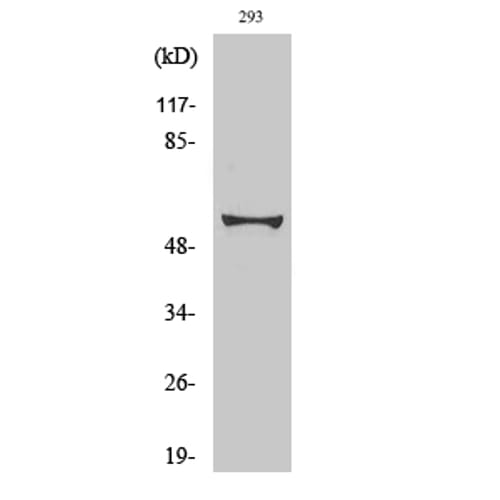
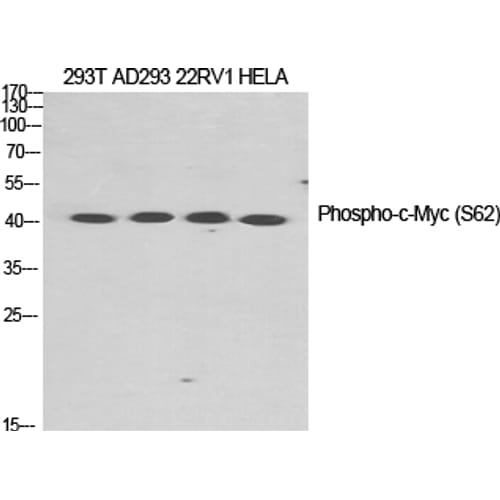
| Specificity | Phospho-c-Myc (S62) Polyclonal Antibody detects endogenous levels of c-Myc protein only when phosphorylated at S62. |
| Purification | The antibody was affinity-purified from rabbit antiserum by affinity-chromatography using epitope-specific immunogen |
| Form | Liquid in PBS containing 50% glycerol, 0.5% BSA and 0.02% sodium azide. |
| Gene Name | MYC |
| Accession No. | P01106 P01108 P09416 |
| Alternate Names | MYC; BHLHE39; Myc proto-oncogene protein; Class E basic helix-loop-helix protein 39; bHLHe39; Proto-oncogene c-Myc; Transcription factor p64 |
| Description | v-myc avian myelocytomatosis viral oncogene homolog(MYC) Homo sapiens The protein encoded by this gene is a multifunctional, nuclear phosphoprotein that plays a role in cell cycle progression, apoptosis and cellular transformation. It functions as a transcription factor that regulates transcription of specific target genes. Mutations, overexpression, rearrangement and translocation of this gene have been associated with a variety of hematopoietic tumors, leukemias and lymphomas, including Burkitt lymphoma. There is evidence to show that alternative translation initiations from an upstream, in-frame non-AUG (CUG) and a downstream AUG start site result in the production of two isoforms with distinct N-termini. The synthesis of non-AUG initiated protein is suppressed in Burkitt's lymphomas, suggesting its importance in the normal function of this gene. [provided by RefSeq, Jul 2008], |
| Cell Pathway/ Category | Stem cell pathway, Cell_Cycle_G1S,Cell_Cycle_G2M_DNA, WNT,WNT-T CELL,β-Catenin, ErbB/HER, MAPK_ERK_Growth,MAPK_G_Protein, PI3K/Akt, Protein_Acetylation |
| Protein Expression | Cervix,Epithelium,Leukemia,Placenta,Promyelocytic l |
| Subcellular Localization | nucleus,nucleoplasm,nucleolus,mitochondrion,cytosol,protein complex, |
| Protein Function | disease:A chromosomal aberration involving MYC may be a cause of a form of B-cell chronic lymphocytic leukemia. Translocation t(8;12)(q24;q22) with BTG1.,disease:Overexpression of MYC is implicated in the etiology of a variety of hematopoietic tumors.,function:Participates in the regulation of gene transcription. Binds DNA both in a non-specific manner and also specifically to recognizes the core sequence 5'-CAC[GA]TG-3'. Seems to activate the transcription of growth-related genes.,online information:Myc entry,PTM:Phosphorylated by PRKDC.,similarity:Contains 1 basic helix-loop-helix (bHLH) domain.,subunit:Efficient DNA binding requires dimerization with another bHLH protein. Binds DNA as a heterodimer with MAX. Interacts with TAF1C and SPAG9. Interacts with PARP10. Interacts with KDM5A and KDM5B., |
| Usage | For Research Use Only! Not for diagnostic or therapeutic procedures. |