

ITT0014
ITT0014
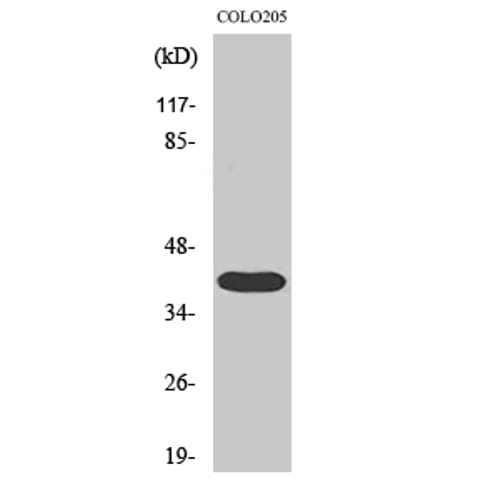
ITT0014
from
$424.00
Price in reward points: 424
- Catalog: ITT0014
- Gene/Protein: MAPKAPK3
- Product Description: Immunotag™ 3pK Polyclonal Antibody
-
Description
-
Specifications
Antibody Specification Datasheet 
IMPORTANT NOTE This product is custom manufactured with a lead time of 3-4 weeks. Once in production, this item cannot be cancelled from an order and is not eligible for return. Target Protein 3pK Clonality Polyclonal Storage/Stability -20°C/1 year Application WB,IHC-p,IF,ELISA Recommended Dilution Western Blot: 1/500 - 1/2000. Immunohistochemistry: 1/100 - 1/300. Immunofluorescence: 1/200 - 1/1000. ELISA: 1/20000. Not yet tested in other applications. Concentration 1 mg/ml Reactive Species Human,Mouse,Rat Host Species Rabbit Immunogen Synthesized peptide derived from 3pK, at AA range: 270-350 Specificity 3pK Polyclonal Antibody detects endogenous levels of 3pK protein. Purification The antibody was affinity-purified from rabbit antiserum by affinity-chromatography using epitope-specific immunogen Form Liquid in PBS containing 50% glycerol, 0.5% BSA and 0.02% sodium azide. Gene Name MAPKAPK3 Accession No. Q16644 Q3UMW7 Q66H84 Alternate Names MAPKAPK3; MAP kinase-activated protein kinase 3; MAPK-activated protein kinase 3; MAPKAP kinase 3; MAPKAP-K3; MAPKAPK-3; MK-3; Chromosome 3p kinase; 3pK Description mitogen-activated protein kinase-activated protein kinase 3(MAPKAPK3) Homo sapiens This gene encodes a member of the Ser/Thr protein kinase family. This kinase functions as a mitogen-activated protein kinase (MAP kinase)- activated protein kinase. MAP kinases are also known as extracellular signal-regulated kinases (ERKs), act as an integration point for multiple biochemical signals. This kinase was shown to be activated by growth inducers and stress stimulation of cells. In vitro studies demonstrated that ERK, p38 MAP kinase and Jun N-terminal kinase were all able to phosphorylate and activate this kinase, which suggested the role of this kinase as an integrative element of signaling in both mitogen and stress responses. This kinase was reported to interact with, phosphorylate and repress the activity of E47, which is a basic helix-loop-helix transcription factor known to be involved in the regulation of tissue-specific gene expression and Cell Pathway/ Category MAPK_ERK_Growth,MAPK_G_Protein,VEGF, Protein Expression Colon,Heart,Skin, Subcellular Localization nucleus,nucleoplasm,cytoplasm,cytosol, Protein Function catalytic activity:ATP + a protein = ADP + a phosphoprotein.,function:Modulator of polycomb-mediated repression, which can be activated either by ERK, p38 and JNK. Substrate of CSBP. In vitro, phosphorylates HSPB1, BMI1/PCGF4 and TCF3.,similarity:Belongs to the protein kinase superfamily. CAMK Ser/Thr protein kinase family.,similarity:Contains 1 protein kinase domain.,subcellular location:Predominantly located in the nucleus, when activated it translocates to the cytoplasm.,subunit:Interacts with TCF3 and with polycomb proteins, such as PCH2 and BMI1/PCGF4.,tissue specificity:Widely expressed, with a higher expression level observed in heart and skeletal muscle. No expression in brain., Usage For Research Use Only! Not for diagnostic or therapeutic procedures. - Reviews
| Antibody Specification | |
| Datasheet | |
| IMPORTANT NOTE | This product is custom manufactured with a lead time of 3-4 weeks. Once in production, this item cannot be cancelled from an order and is not eligible for return. |
| Target Protein | 3pK |
| Clonality | Polyclonal |
| Storage/Stability | -20°C/1 year |
| Application | WB,IHC-p,IF,ELISA |
| Recommended Dilution | Western Blot: 1/500 - 1/2000. Immunohistochemistry: 1/100 - 1/300. Immunofluorescence: 1/200 - 1/1000. ELISA: 1/20000. Not yet tested in other applications. |
| Concentration | 1 mg/ml |
| Reactive Species | Human,Mouse,Rat |
| Host Species | Rabbit |
| Immunogen | Synthesized peptide derived from 3pK, at AA range: 270-350 |
| Specificity | 3pK Polyclonal Antibody detects endogenous levels of 3pK protein. |
| Purification | The antibody was affinity-purified from rabbit antiserum by affinity-chromatography using epitope-specific immunogen |
| Form | Liquid in PBS containing 50% glycerol, 0.5% BSA and 0.02% sodium azide. |
| Gene Name | MAPKAPK3 |
| Accession No. | Q16644 Q3UMW7 Q66H84 |
| Alternate Names | MAPKAPK3; MAP kinase-activated protein kinase 3; MAPK-activated protein kinase 3; MAPKAP kinase 3; MAPKAP-K3; MAPKAPK-3; MK-3; Chromosome 3p kinase; 3pK |
| Description | mitogen-activated protein kinase-activated protein kinase 3(MAPKAPK3) Homo sapiens This gene encodes a member of the Ser/Thr protein kinase family. This kinase functions as a mitogen-activated protein kinase (MAP kinase)- activated protein kinase. MAP kinases are also known as extracellular signal-regulated kinases (ERKs), act as an integration point for multiple biochemical signals. This kinase was shown to be activated by growth inducers and stress stimulation of cells. In vitro studies demonstrated that ERK, p38 MAP kinase and Jun N-terminal kinase were all able to phosphorylate and activate this kinase, which suggested the role of this kinase as an integrative element of signaling in both mitogen and stress responses. This kinase was reported to interact with, phosphorylate and repress the activity of E47, which is a basic helix-loop-helix transcription factor known to be involved in the regulation of tissue-specific gene expression and |
| Cell Pathway/ Category | MAPK_ERK_Growth,MAPK_G_Protein,VEGF, |
| Protein Expression | Colon,Heart,Skin, |
| Subcellular Localization | nucleus,nucleoplasm,cytoplasm,cytosol, |
| Protein Function | catalytic activity:ATP + a protein = ADP + a phosphoprotein.,function:Modulator of polycomb-mediated repression, which can be activated either by ERK, p38 and JNK. Substrate of CSBP. In vitro, phosphorylates HSPB1, BMI1/PCGF4 and TCF3.,similarity:Belongs to the protein kinase superfamily. CAMK Ser/Thr protein kinase family.,similarity:Contains 1 protein kinase domain.,subcellular location:Predominantly located in the nucleus, when activated it translocates to the cytoplasm.,subunit:Interacts with TCF3 and with polycomb proteins, such as PCH2 and BMI1/PCGF4.,tissue specificity:Widely expressed, with a higher expression level observed in heart and skeletal muscle. No expression in brain., |
| Usage | For Research Use Only! Not for diagnostic or therapeutic procedures. |