

ITT0394
ITT0394
ITT0394
from
$424.00
Price in reward points: 424
- Catalog: ITT0394
- Gene/Protein: ATG4B
- Product Description: Immunotag™ Atg4b Polyclonal Antibody
-
Description
-
Specifications
Antibody Specification Datasheet 
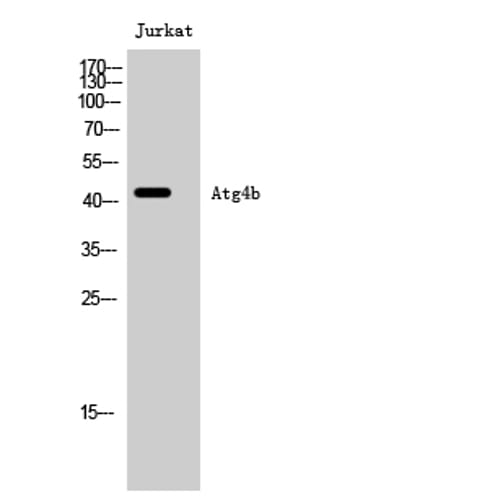
IMPORTANT NOTE This product is custom manufactured with a lead time of 3-4 weeks. Once in production, this item cannot be cancelled from an order and is not eligible for return. Target Protein ATG4b Clonality Polyclonal Storage/Stability -20°C/1 year Application WB,IHC-p,ELISA Recommended Dilution Western Blot: 1/500 - 1/2000. Immunohistochemistry: 1/100 - 1/300. ELISA: 1/20000. Not yet tested in other applications. Concentration 1 mg/ml Reactive Species Human,Mouse Host Species Rabbit Immunogen The antiserum was produced against synthesized peptide derived from human ATG4B. AA range:71-120 Specificity Atg4b Polyclonal Antibody detects endogenous levels of Atg4b protein. Purification The antibody was affinity-purified from rabbit antiserum by affinity-chromatography using epitope-specific immunogen Form Liquid in PBS containing 50% glycerol, 0.5% BSA and 0.02% sodium azide. Gene Name ATG4B Accession No. Q9Y4P1 Q8BGE6 Alternate Names ATG4B; APG4B; AUTL1; KIAA0943; Cysteine protease ATG4B; AUT-like 1 cysteine endopeptidase; Autophagin-1; Autophagy-related cysteine endopeptidase 1; Autophagy-related protein 4 homolog B; hAPG4B Description autophagy related 4B cysteine peptidase(ATG4B) Homo sapiens Autophagy is the process by which endogenous proteins and damaged organelles are destroyed intracellularly. Autophagy is postulated to be essential for cell homeostasis and cell remodeling during differentiation, metamorphosis, non-apoptotic cell death, and aging. Reduced levels of autophagy have been described in some malignant tumors, and a role for autophagy in controlling the unregulated cell growth linked to cancer has been proposed. This gene encodes a member of the autophagin protein family. The encoded protein is also designated as a member of the C-54 family of cysteine proteases. Alternate transcriptional splice variants, encoding different isoforms, have been characterized. [provided by RefSeq, Jul 2008], Cell Pathway/ Category Regulation of autophagy, Protein Expression Brain,Embryo,Endometrium,Epithelium,Hippocampus,Liver,Placenta,Test Subcellular Localization cytoplasm,cytosol, Protein Function enzyme regulation:Inhibited by N-ethylmaleimide.,function:Cysteine protease required for autophagy, which cleaves the C-terminal part of either MAP1LC3, GABARAPL2 or GABARAP, allowing the liberation of form I. A subpopulation of form I is subsequently converted to a smaller form (form II). Form II, with a revealed C-terminal glycine, is considered to be the phosphatidylethanolamine (PE)-conjugated form, and has the capacity for the binding to autophagosomes.,similarity:Belongs to the peptidase C54 family.,tissue specificity:Mainly expressed in the skeletal muscle, followed by brain, heart, liver and pancreas., Usage For Research Use Only! Not for diagnostic or therapeutic procedures. - Reviews
| Antibody Specification | |
| Datasheet | |
| IMPORTANT NOTE | This product is custom manufactured with a lead time of 3-4 weeks. Once in production, this item cannot be cancelled from an order and is not eligible for return. |
| Target Protein | ATG4b |
| Clonality | Polyclonal |
| Storage/Stability | -20°C/1 year |
| Application | WB,IHC-p,ELISA |
| Recommended Dilution | Western Blot: 1/500 - 1/2000. Immunohistochemistry: 1/100 - 1/300. ELISA: 1/20000. Not yet tested in other applications. |
| Concentration | 1 mg/ml |
| Reactive Species | Human,Mouse |
| Host Species | Rabbit |
| Immunogen | The antiserum was produced against synthesized peptide derived from human ATG4B. AA range:71-120 |
| Specificity | Atg4b Polyclonal Antibody detects endogenous levels of Atg4b protein. |
| Purification | The antibody was affinity-purified from rabbit antiserum by affinity-chromatography using epitope-specific immunogen |
| Form | Liquid in PBS containing 50% glycerol, 0.5% BSA and 0.02% sodium azide. |
| Gene Name | ATG4B |
| Accession No. | Q9Y4P1 Q8BGE6 |
| Alternate Names | ATG4B; APG4B; AUTL1; KIAA0943; Cysteine protease ATG4B; AUT-like 1 cysteine endopeptidase; Autophagin-1; Autophagy-related cysteine endopeptidase 1; Autophagy-related protein 4 homolog B; hAPG4B |
| Description | autophagy related 4B cysteine peptidase(ATG4B) Homo sapiens Autophagy is the process by which endogenous proteins and damaged organelles are destroyed intracellularly. Autophagy is postulated to be essential for cell homeostasis and cell remodeling during differentiation, metamorphosis, non-apoptotic cell death, and aging. Reduced levels of autophagy have been described in some malignant tumors, and a role for autophagy in controlling the unregulated cell growth linked to cancer has been proposed. This gene encodes a member of the autophagin protein family. The encoded protein is also designated as a member of the C-54 family of cysteine proteases. Alternate transcriptional splice variants, encoding different isoforms, have been characterized. [provided by RefSeq, Jul 2008], |
| Cell Pathway/ Category | Regulation of autophagy, |
| Protein Expression | Brain,Embryo,Endometrium,Epithelium,Hippocampus,Liver,Placenta,Test |
| Subcellular Localization | cytoplasm,cytosol, |
| Protein Function | enzyme regulation:Inhibited by N-ethylmaleimide.,function:Cysteine protease required for autophagy, which cleaves the C-terminal part of either MAP1LC3, GABARAPL2 or GABARAP, allowing the liberation of form I. A subpopulation of form I is subsequently converted to a smaller form (form II). Form II, with a revealed C-terminal glycine, is considered to be the phosphatidylethanolamine (PE)-conjugated form, and has the capacity for the binding to autophagosomes.,similarity:Belongs to the peptidase C54 family.,tissue specificity:Mainly expressed in the skeletal muscle, followed by brain, heart, liver and pancreas., |
| Usage | For Research Use Only! Not for diagnostic or therapeutic procedures. |