

ITT0516
ITT0516
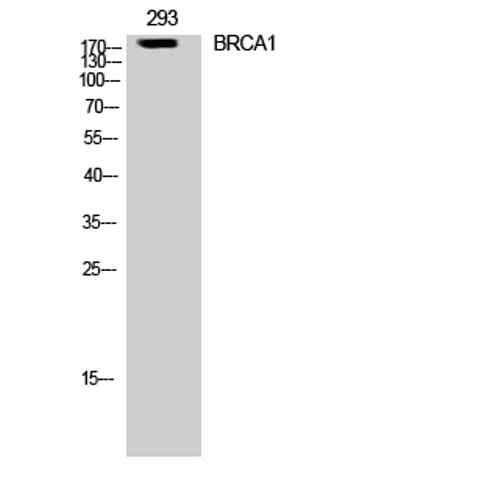
ITT0516
from
$424.00
Price in reward points: 424
- Catalog: ITT0516
- Gene/Protein: BRCA1
- Product Description: Immunotag™ BRCA1 Polyclonal Antibody
-
Description
-
Specifications
Antibody Specification Datasheet 
IMPORTANT NOTE This product is custom manufactured with a lead time of 3-4 weeks. Once in production, this item cannot be cancelled from an order and is not eligible for return. Target Protein BRCA1 Clonality Polyclonal Storage/Stability -20°C/1 year Application WB,ELISA Recommended Dilution Western Blot: 1/500 - 1/2000. ELISA: 1/5000. Not yet tested in other applications. Concentration 1 mg/ml Reactive Species Human Host Species Rabbit Immunogen The antiserum was produced against synthesized peptide derived from human BRCA1. AA range:1423-1472 Specificity BRCA1 Polyclonal Antibody detects endogenous levels of BRCA1 protein. Purification The antibody was affinity-purified from rabbit antiserum by affinity-chromatography using epitope-specific immunogen Form Liquid in PBS containing 50% glycerol, 0.5% BSA and 0.02% sodium azide. Gene Name BRCA1 Accession No. P38398 P48754 Alternate Names BRCA1; RNF53; Breast cancer type 1 susceptibility protein; RING finger protein 53 Description BRCA1, DNA repair associated(BRCA1) Homo sapiens This gene encodes a nuclear phosphoprotein that plays a role in maintaining genomic stability, and it also acts as a tumor suppressor. The encoded protein combines with other tumor suppressors, DNA damage sensors, and signal transducers to form a large multi-subunit protein complex known as the BRCA1-associated genome surveillance complex (BASC). This gene product associates with RNA polymerase II, and through the C-terminal domain, also interacts with histone deacetylase complexes. This protein thus plays a role in transcription, DNA repair of double-stranded breaks, and recombination. Mutations in this gene are responsible for approximately 40% of inherited breast cancers and more than 80% of inherited breast and ovarian cancers. Alternative splicing plays a role in modulating the subcellular localization and physiological function of this gene. Many alternatively spliced transcript varian Cell Pathway/ Category Ubiquitin mediated proteolysis, Protein Expression Bladder,Blood,Epithelium,Mammary gland,PCR rescued clones,Peripheral Nervou Subcellular Localization ubiquitin ligase complex,condensed nuclear chromosome,lateral element,nucleus,nucleoplasm,chromosome,cytoplasm,plasma membrane,gamma-tubulin ring complex,integral component of membrane,intracellular ribonucleoprotein complex, Protein Function disease:Defects in BRCA1 are a cause of genetic susceptibility to breast cancer (BC) [MIM:113705, 114480]. BC is an extremely common malignancy, affecting one in eight women during their lifetime. A positive family history has been identified as major contributor to risk of development of the disease, and this link is striking for early-onset breast cancer. Mutations in BRCA1 are thought to be responsible for 45% of inherited breast cancer. Moreover, BRCA1 carriers have a 4-fold increased risk of colon cancer, whereas male carriers face a 3-fold increased risk of prostate cancer. Cells lacking BRCA1 show defects in DNA repair by homologous recombination.,disease:Defects in BRCA1 are a cause of genetic susceptibility to ovarian cancer [MIM:113705].,disease:Defects in BRCA1 are a cause of susceptibility to familial breast-ovarian cancer type 1 (BROVCA1) [MIM:604370]. Mutations in BRCA1 are thought to be responsible for more than 80% of inherited breast-ovarian cancer.,domain:The BRCT domains recognize and bind phosphorylated pSXXF motif on proteins. The interaction with the phosphorylated pSXXF motif of FAM175A/Abraxas, recruits BRCA1 at DNA damage sites.,domain:The RING-type zinc finger domain interacts with BAP1.,function:The BRCA1-BARD1 heterodimer coordinates a diverse range of cellular pathways such as DNA damage repair, ubiquitination and transcriptional regulation to maintain genomic stability. Acts by mediating ubiquitin E3 ligase activity that is required for its tumor suppressor function. Plays a central role in DNA repair by facilitating cellular response to DNA repair. Required for appropriate cell cycle arrests after ionizing irradiation in both the S-phase and the G2 phase of the cell cycle. Involved in transcriptional regulation of P21 in response to DNA damage. Required for FANCD2 targeting to sites of DNA damage. May function as a transcriptional regulator. Inhibits lipid synthesis by binding to inactive phosphorylated ACACA and preventing its dephosphorylation.,online information:BRCA1 entry,online information:The Singapore human mutation and polymorphism database,pathway:Protein modification; protein ubiquitination.,polymorphism:There is evidence that the presence of the rare form of Gln-356-Arg and Leu-871-Pro polymorphisms may be associated with an increased risk for developing ovarian cancer.,PTM:Phosphorylated in response to IR, UV, and various stimuli that cause checkpoint activation, probably by ATM or ATR.,similarity:Contains 1 RING-type zinc finger.,similarity:Contains 2 BRCT domains.,subcellular location:Localizes at sites of DNA damage at double-strand breaks (DSBs); recruitment to DNA damage sites is mediated by the BRCA1-A complex.,subunit:Part of the BRCA1-associated genome surveillance complex (BASC), which contains BRCA1, MSH2, MSH6, MLH1, ATM, BLM, PMS2 and the RAD50-MRE11-NBN protein complex. This association could be a dynamic process changing throughout the cell cycle and within subnuclear domains. Component of the BRCA1-A complex, at least composed of the BRCA1, BARD1, UIMC1/RAP80, FAM175A/Abraxas, BRCC3/BRCC36, BRE/BRCC45 and MERIT40/NBA1. Interacts (via BRCT domains) with FAM175A/Abraxas and RBBP8. Associates with RNA polymerase II holoenzyme. Interacts with SMC1A and COBRA1/NELFB. Interacts (via BRCT domains) with BRIP1. Interacts with FANCD2 (ubiquitinated). Interacts with BAP1. Interacts with DCLRE1C/Artemis and CLSPN. Interacts with H2AFX (phosphorylated on 'Ser-140'). Interacts with CHEK1/CHK1. Interacts with BRCC3. Interacts (via BRCT domains) with ACACA (phosphorylated); the interaction prevents dephosphorylation of ACACA.,tissue specificity:Isoform 1 and isoform 3 are widely expressed. Isoform 3 is reduced or absent in several breast and ovarian cancer cell lines., Usage For Research Use Only! Not for diagnostic or therapeutic procedures. - Reviews
| Antibody Specification | |
| Datasheet | |
| IMPORTANT NOTE | This product is custom manufactured with a lead time of 3-4 weeks. Once in production, this item cannot be cancelled from an order and is not eligible for return. |
| Target Protein | BRCA1 |
| Clonality | Polyclonal |
| Storage/Stability | -20°C/1 year |
| Application | WB,ELISA |
| Recommended Dilution | Western Blot: 1/500 - 1/2000. ELISA: 1/5000. Not yet tested in other applications. |
| Concentration | 1 mg/ml |
| Reactive Species | Human |
| Host Species | Rabbit |
| Immunogen | The antiserum was produced against synthesized peptide derived from human BRCA1. AA range:1423-1472 |
| Specificity | BRCA1 Polyclonal Antibody detects endogenous levels of BRCA1 protein. |
| Purification | The antibody was affinity-purified from rabbit antiserum by affinity-chromatography using epitope-specific immunogen |
| Form | Liquid in PBS containing 50% glycerol, 0.5% BSA and 0.02% sodium azide. |
| Gene Name | BRCA1 |
| Accession No. | P38398 P48754 |
| Alternate Names | BRCA1; RNF53; Breast cancer type 1 susceptibility protein; RING finger protein 53 |
| Description | BRCA1, DNA repair associated(BRCA1) Homo sapiens This gene encodes a nuclear phosphoprotein that plays a role in maintaining genomic stability, and it also acts as a tumor suppressor. The encoded protein combines with other tumor suppressors, DNA damage sensors, and signal transducers to form a large multi-subunit protein complex known as the BRCA1-associated genome surveillance complex (BASC). This gene product associates with RNA polymerase II, and through the C-terminal domain, also interacts with histone deacetylase complexes. This protein thus plays a role in transcription, DNA repair of double-stranded breaks, and recombination. Mutations in this gene are responsible for approximately 40% of inherited breast cancers and more than 80% of inherited breast and ovarian cancers. Alternative splicing plays a role in modulating the subcellular localization and physiological function of this gene. Many alternatively spliced transcript varian |
| Cell Pathway/ Category | Ubiquitin mediated proteolysis, |
| Protein Expression | Bladder,Blood,Epithelium,Mammary gland,PCR rescued clones,Peripheral Nervou |
| Subcellular Localization | ubiquitin ligase complex,condensed nuclear chromosome,lateral element,nucleus,nucleoplasm,chromosome,cytoplasm,plasma membrane,gamma-tubulin ring complex,integral component of membrane,intracellular ribonucleoprotein complex, |
| Protein Function | disease:Defects in BRCA1 are a cause of genetic susceptibility to breast cancer (BC) [MIM:113705, 114480]. BC is an extremely common malignancy, affecting one in eight women during their lifetime. A positive family history has been identified as major contributor to risk of development of the disease, and this link is striking for early-onset breast cancer. Mutations in BRCA1 are thought to be responsible for 45% of inherited breast cancer. Moreover, BRCA1 carriers have a 4-fold increased risk of colon cancer, whereas male carriers face a 3-fold increased risk of prostate cancer. Cells lacking BRCA1 show defects in DNA repair by homologous recombination.,disease:Defects in BRCA1 are a cause of genetic susceptibility to ovarian cancer [MIM:113705].,disease:Defects in BRCA1 are a cause of susceptibility to familial breast-ovarian cancer type 1 (BROVCA1) [MIM:604370]. Mutations in BRCA1 are thought to be responsible for more than 80% of inherited breast-ovarian cancer.,domain:The BRCT domains recognize and bind phosphorylated pSXXF motif on proteins. The interaction with the phosphorylated pSXXF motif of FAM175A/Abraxas, recruits BRCA1 at DNA damage sites.,domain:The RING-type zinc finger domain interacts with BAP1.,function:The BRCA1-BARD1 heterodimer coordinates a diverse range of cellular pathways such as DNA damage repair, ubiquitination and transcriptional regulation to maintain genomic stability. Acts by mediating ubiquitin E3 ligase activity that is required for its tumor suppressor function. Plays a central role in DNA repair by facilitating cellular response to DNA repair. Required for appropriate cell cycle arrests after ionizing irradiation in both the S-phase and the G2 phase of the cell cycle. Involved in transcriptional regulation of P21 in response to DNA damage. Required for FANCD2 targeting to sites of DNA damage. May function as a transcriptional regulator. Inhibits lipid synthesis by binding to inactive phosphorylated ACACA and preventing its dephosphorylation.,online information:BRCA1 entry,online information:The Singapore human mutation and polymorphism database,pathway:Protein modification; protein ubiquitination.,polymorphism:There is evidence that the presence of the rare form of Gln-356-Arg and Leu-871-Pro polymorphisms may be associated with an increased risk for developing ovarian cancer.,PTM:Phosphorylated in response to IR, UV, and various stimuli that cause checkpoint activation, probably by ATM or ATR.,similarity:Contains 1 RING-type zinc finger.,similarity:Contains 2 BRCT domains.,subcellular location:Localizes at sites of DNA damage at double-strand breaks (DSBs); recruitment to DNA damage sites is mediated by the BRCA1-A complex.,subunit:Part of the BRCA1-associated genome surveillance complex (BASC), which contains BRCA1, MSH2, MSH6, MLH1, ATM, BLM, PMS2 and the RAD50-MRE11-NBN protein complex. This association could be a dynamic process changing throughout the cell cycle and within subnuclear domains. Component of the BRCA1-A complex, at least composed of the BRCA1, BARD1, UIMC1/RAP80, FAM175A/Abraxas, BRCC3/BRCC36, BRE/BRCC45 and MERIT40/NBA1. Interacts (via BRCT domains) with FAM175A/Abraxas and RBBP8. Associates with RNA polymerase II holoenzyme. Interacts with SMC1A and COBRA1/NELFB. Interacts (via BRCT domains) with BRIP1. Interacts with FANCD2 (ubiquitinated). Interacts with BAP1. Interacts with DCLRE1C/Artemis and CLSPN. Interacts with H2AFX (phosphorylated on 'Ser-140'). Interacts with CHEK1/CHK1. Interacts with BRCC3. Interacts (via BRCT domains) with ACACA (phosphorylated); the interaction prevents dephosphorylation of ACACA.,tissue specificity:Isoform 1 and isoform 3 are widely expressed. Isoform 3 is reduced or absent in several breast and ovarian cancer cell lines., |
| Usage | For Research Use Only! Not for diagnostic or therapeutic procedures. |