

ITT1177
ITT1177
ITT1177
from
$424.00
Price in reward points: 424
- Catalog: ITT1177
- Gene/Protein: CCNE1
- Product Description: Immunotag™ Cyclin E1 Polyclonal Antibody
-
Description
-
Specifications
Antibody Specification Datasheet 
IMPORTANT NOTE This product is custom manufactured with a lead time of 3-4 weeks. Once in production, this item cannot be cancelled from an order and is not eligible for return. Target Protein Cyclin E1 Clonality Polyclonal Storage/Stability -20°C/1 year Application WB,IHC-p,IF,ELISA Recommended Dilution Western Blot: 1/500 - 1/2000. Immunohistochemistry: 1/100 - 1/300. Immunofluorescence: 1/200 - 1/1000. ELISA: 1/10000. Not yet tested in other applications. Concentration 1 mg/ml Reactive Species Human Host Species Rabbit Immunogen The antiserum was produced against synthesized peptide derived from human Cyclin E1. AA range:361-410 Specificity Cyclin E1 Polyclonal Antibody detects endogenous levels of Cyclin E1 protein. Purification The antibody was affinity-purified from rabbit antiserum by affinity-chromatography using epitope-specific immunogen Form Liquid in PBS containing 50% glycerol, 0.5% BSA and 0.02% sodium azide. Gene Name CCNE1 Accession No. P24864 Q61457 Alternate Names CCNE1; CCNE; G1/S-specific cyclin-E1 Description cyclin E1(CCNE1) Homo sapiens The protein encoded by this gene belongs to the highly conserved cyclin family, whose members are characterized by a dramatic periodicity in protein abundance through the cell cycle. Cyclins function as regulators of CDK kinases. Different cyclins exhibit distinct expression and degradation patterns which contribute to the temporal coordination of each mitotic event. This cyclin forms a complex with and functions as a regulatory subunit of CDK2, whose activity is required for cell cycle G1/S transition. This protein accumulates at the G1-S phase boundary and is degraded as cells progress through S phase. Overexpression of this gene has been observed in many tumors, which results in chromosome instability, and thus may contribute to tumorigenesis. This protein was found to associate with, and be involved in, the phosphorylation of NPAT protein (nuclear protein mapped to the ATM locus), which participates in Cell Pathway/ Category Cell_Cycle_G1S,Cell_Cycle_G2M_DNA,Oocyte meiosis,p53,Pathways in cancer,Prostate cancer,Small cell lung cancer, Protein Expression Placenta, Subcellular Localization cyclin-dependent protein kinase holoenzyme complex,nucleus,nucleoplasm,cytosol,cyclin E1-CDK2 complex, Protein Function function:Essential for the control of the cell cycle at the G1/S (start) transition.,PTM:Phosphorylation of Thr-395 by GSK3 and of Ser-399 by CDK2 accelerates degradation via the ubiquitin proteasome pathway. Phosphorylated upon DNA damage, probably by ATM or ATR.,similarity:Belongs to the cyclin family. Cyclin E subfamily.,subunit:Interacts with a member of the CDK2/CDK protein kinases to form a serine/threonine kinase holoenzyme complex. The cyclin subunit imparts substrate specificity to the complex. Interacts with retinoblastoma binding protein 3 and retinoblastoma-like protein 1. Found in a complex with CDK2, CABLES1 and CCNA1 (By similarity). Part of a complex consisting of UHRF2, CDK2 and CCNE1.,tissue specificity:Highly expressed in testis and placenta. Low levels in bronchial epithelial cells., Usage For Research Use Only! Not for diagnostic or therapeutic procedures. - Reviews
| Antibody Specification | |
| Datasheet | |
| IMPORTANT NOTE | This product is custom manufactured with a lead time of 3-4 weeks. Once in production, this item cannot be cancelled from an order and is not eligible for return. |
| Target Protein | Cyclin E1 |
| Clonality | Polyclonal |
| Storage/Stability | -20°C/1 year |
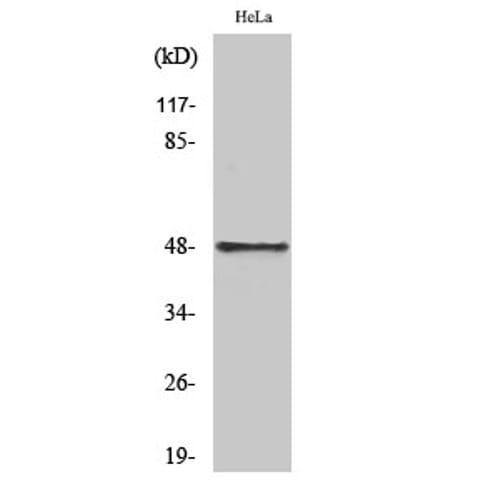
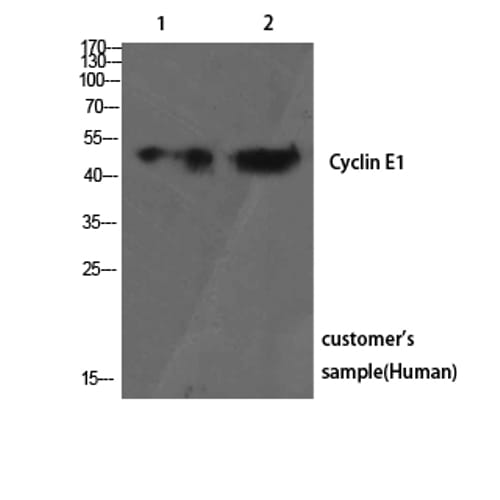
| Application | WB,IHC-p,IF,ELISA |
| Recommended Dilution | Western Blot: 1/500 - 1/2000. Immunohistochemistry: 1/100 - 1/300. Immunofluorescence: 1/200 - 1/1000. ELISA: 1/10000. Not yet tested in other applications. |
| Concentration | 1 mg/ml |
| Reactive Species | Human |
| Host Species | Rabbit |
| Immunogen | The antiserum was produced against synthesized peptide derived from human Cyclin E1. AA range:361-410 |
| Specificity | Cyclin E1 Polyclonal Antibody detects endogenous levels of Cyclin E1 protein. |
| Purification | The antibody was affinity-purified from rabbit antiserum by affinity-chromatography using epitope-specific immunogen |
| Form | Liquid in PBS containing 50% glycerol, 0.5% BSA and 0.02% sodium azide. |
| Gene Name | CCNE1 |
| Accession No. | P24864 Q61457 |
| Alternate Names | CCNE1; CCNE; G1/S-specific cyclin-E1 |
| Description | cyclin E1(CCNE1) Homo sapiens The protein encoded by this gene belongs to the highly conserved cyclin family, whose members are characterized by a dramatic periodicity in protein abundance through the cell cycle. Cyclins function as regulators of CDK kinases. Different cyclins exhibit distinct expression and degradation patterns which contribute to the temporal coordination of each mitotic event. This cyclin forms a complex with and functions as a regulatory subunit of CDK2, whose activity is required for cell cycle G1/S transition. This protein accumulates at the G1-S phase boundary and is degraded as cells progress through S phase. Overexpression of this gene has been observed in many tumors, which results in chromosome instability, and thus may contribute to tumorigenesis. This protein was found to associate with, and be involved in, the phosphorylation of NPAT protein (nuclear protein mapped to the ATM locus), which participates in |
| Cell Pathway/ Category | Cell_Cycle_G1S,Cell_Cycle_G2M_DNA,Oocyte meiosis,p53,Pathways in cancer,Prostate cancer,Small cell lung cancer, |
| Protein Expression | Placenta, |
| Subcellular Localization | cyclin-dependent protein kinase holoenzyme complex,nucleus,nucleoplasm,cytosol,cyclin E1-CDK2 complex, |
| Protein Function | function:Essential for the control of the cell cycle at the G1/S (start) transition.,PTM:Phosphorylation of Thr-395 by GSK3 and of Ser-399 by CDK2 accelerates degradation via the ubiquitin proteasome pathway. Phosphorylated upon DNA damage, probably by ATM or ATR.,similarity:Belongs to the cyclin family. Cyclin E subfamily.,subunit:Interacts with a member of the CDK2/CDK protein kinases to form a serine/threonine kinase holoenzyme complex. The cyclin subunit imparts substrate specificity to the complex. Interacts with retinoblastoma binding protein 3 and retinoblastoma-like protein 1. Found in a complex with CDK2, CABLES1 and CCNA1 (By similarity). Part of a complex consisting of UHRF2, CDK2 and CCNE1.,tissue specificity:Highly expressed in testis and placenta. Low levels in bronchial epithelial cells., |
| Usage | For Research Use Only! Not for diagnostic or therapeutic procedures. |