

ITT1742
ITT1742
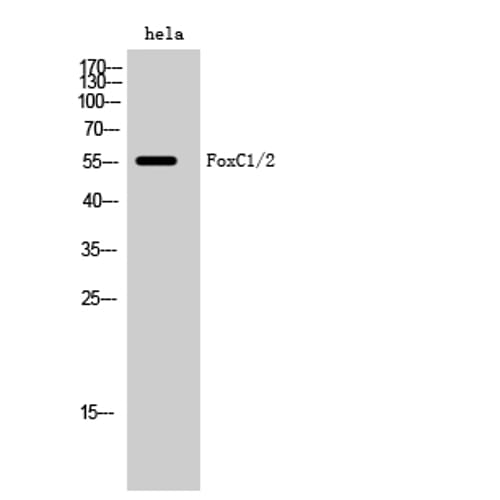
ITT1742
from
$424.00
Price in reward points: 424
- Catalog: ITT1742
- Gene/Protein: FOXC1/FOXC2
- Product Description: Immunotag™ FoxC1/2 Polyclonal Antibody
-
Description
-
Specifications
Antibody Specification Datasheet 
IMPORTANT NOTE This product is custom manufactured with a lead time of 3-4 weeks. Once in production, this item cannot be cancelled from an order and is not eligible for return. Target Protein FOXC1/2 Clonality Polyclonal Storage/Stability -20°C/1 year Application WB,IHC-p,IF,ELISA Recommended Dilution Western Blot: 1/500 - 1/2000. Immunohistochemistry: 1/100 - 1/300. Immunofluorescence: 1/200 - 1/1000. ELISA: 1/40000. Not yet tested in other applications. Concentration 1 mg/ml Reactive Species Human,Mouse,Rat Host Species Rabbit Immunogen Synthesized peptide derived from FoxC1/2, at AA range: 120-200 Specificity FoxC1/2 Polyclonal Antibody detects endogenous levels of FoxC1/2 protein. Purification The antibody was affinity-purified from rabbit antiserum by affinity-chromatography using epitope-specific immunogen Form Liquid in PBS containing 50% glycerol, 0.5% BSA and 0.02% sodium azide. Gene Name FOXC1/FOXC2 Accession No. Q12948/Q99958 Q63246 Alternate Names FOXC1; FKHL7; FREAC3; Forkhead box protein C1; Forkhead-related protein FKHL7; Forkhead-related transcription factor 3; FREAC-3; FOXC2; FKHL14; MFH1; Forkhead box protein C2; Forkhead-related protein FKHL14; Mesenchyme fork head protein 1; Description forkhead box C1(FOXC1) Homo sapiens This gene belongs to the forkhead family of transcription factors which is characterized by a distinct DNA-binding forkhead domain. The specific function of this gene has not yet been determined; however, it has been shown to play a role in the regulation of embryonic and ocular development. Mutations in this gene cause various glaucoma phenotypes including primary congenital glaucoma, autosomal dominant iridogoniodysgenesis anomaly, and Axenfeld-Rieger anomaly. [provided by RefSeq, Jul 2008], Protein Expression Erythroleukemia, Subcellular Localization nucleus,nucleoplasm,nuclear heterochromatin,cytoplasm, Protein Function disease:Defects in FOXC1 are a cause of Axenfeld-Rieger syndrome (ARS) [MIM:601090]; also known as Axenfeld syndrome or Axenfeld anomaly. It is characterized by posterior corneal embryotoxon, prominent Schwalbe line and iris adhesion to the Schwalbe line. Other features may be hypertelorism (wide spacing of the eyes), hypoplasia of the malar bones, congenital absence of some teeth and mental retardation. When associated with tooth anomalies, the disorder is known as Rieger syndrome. Glaucoma is a progressive blinding condition that occurs in approximately half of patients with Axenfeld-Rieger malformations.,disease:Defects in FOXC1 are a cause of Peters anomaly [MIM:604229]. Peters anomaly consists of a central corneal leukoma, absence of the posterior corneal stroma and Descemet membrane, and a variable degree of iris and lenticular attachments to the central aspect of the posterior cornea.,disease:Defects in FOXC1 are the cause of iridogoniodysgenesis anomaly (IGDA) [MIM:601631]. IGDA is an autosomal dominant phenotype characterized by iris hypoplasia, goniodysgenesis, and juvenile glaucoma.,function:Binding of FREAC-3 and FREAC-4 to their cognate sites results in bending of the DNA at an angle of 80-90 degrees.,similarity:Contains 1 fork-head DNA-binding domain.,subunit:Monomer.,tissue specificity:Expressed in all tissues and cell lines examined., Usage For Research Use Only! Not for diagnostic or therapeutic procedures. - Reviews
| Antibody Specification | |
| Datasheet | |
| IMPORTANT NOTE | This product is custom manufactured with a lead time of 3-4 weeks. Once in production, this item cannot be cancelled from an order and is not eligible for return. |
| Target Protein | FOXC1/2 |
| Clonality | Polyclonal |
| Storage/Stability | -20°C/1 year |
| Application | WB,IHC-p,IF,ELISA |
| Recommended Dilution | Western Blot: 1/500 - 1/2000. Immunohistochemistry: 1/100 - 1/300. Immunofluorescence: 1/200 - 1/1000. ELISA: 1/40000. Not yet tested in other applications. |
| Concentration | 1 mg/ml |
| Reactive Species | Human,Mouse,Rat |
| Host Species | Rabbit |
| Immunogen | Synthesized peptide derived from FoxC1/2, at AA range: 120-200 |
| Specificity | FoxC1/2 Polyclonal Antibody detects endogenous levels of FoxC1/2 protein. |
| Purification | The antibody was affinity-purified from rabbit antiserum by affinity-chromatography using epitope-specific immunogen |
| Form | Liquid in PBS containing 50% glycerol, 0.5% BSA and 0.02% sodium azide. |
| Gene Name | FOXC1/FOXC2 |
| Accession No. | Q12948/Q99958 Q63246 |
| Alternate Names | FOXC1; FKHL7; FREAC3; Forkhead box protein C1; Forkhead-related protein FKHL7; Forkhead-related transcription factor 3; FREAC-3; FOXC2; FKHL14; MFH1; Forkhead box protein C2; Forkhead-related protein FKHL14; Mesenchyme fork head protein 1; |
| Description | forkhead box C1(FOXC1) Homo sapiens This gene belongs to the forkhead family of transcription factors which is characterized by a distinct DNA-binding forkhead domain. The specific function of this gene has not yet been determined; however, it has been shown to play a role in the regulation of embryonic and ocular development. Mutations in this gene cause various glaucoma phenotypes including primary congenital glaucoma, autosomal dominant iridogoniodysgenesis anomaly, and Axenfeld-Rieger anomaly. [provided by RefSeq, Jul 2008], |
| Protein Expression | Erythroleukemia, |
| Subcellular Localization | nucleus,nucleoplasm,nuclear heterochromatin,cytoplasm, |
| Protein Function | disease:Defects in FOXC1 are a cause of Axenfeld-Rieger syndrome (ARS) [MIM:601090]; also known as Axenfeld syndrome or Axenfeld anomaly. It is characterized by posterior corneal embryotoxon, prominent Schwalbe line and iris adhesion to the Schwalbe line. Other features may be hypertelorism (wide spacing of the eyes), hypoplasia of the malar bones, congenital absence of some teeth and mental retardation. When associated with tooth anomalies, the disorder is known as Rieger syndrome. Glaucoma is a progressive blinding condition that occurs in approximately half of patients with Axenfeld-Rieger malformations.,disease:Defects in FOXC1 are a cause of Peters anomaly [MIM:604229]. Peters anomaly consists of a central corneal leukoma, absence of the posterior corneal stroma and Descemet membrane, and a variable degree of iris and lenticular attachments to the central aspect of the posterior cornea.,disease:Defects in FOXC1 are the cause of iridogoniodysgenesis anomaly (IGDA) [MIM:601631]. IGDA is an autosomal dominant phenotype characterized by iris hypoplasia, goniodysgenesis, and juvenile glaucoma.,function:Binding of FREAC-3 and FREAC-4 to their cognate sites results in bending of the DNA at an angle of 80-90 degrees.,similarity:Contains 1 fork-head DNA-binding domain.,subunit:Monomer.,tissue specificity:Expressed in all tissues and cell lines examined., |
| Usage | For Research Use Only! Not for diagnostic or therapeutic procedures. |