

ITT2478
ITT2478
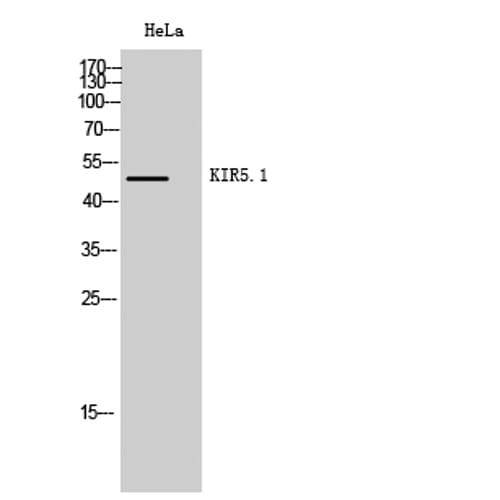
ITT2478
from
$424.00
Price in reward points: 424
- Catalog: ITT2478
- Gene/Protein: KCNJ16
- Product Description: Immunotag™ KIR5.1 Polyclonal Antibody
-
Description
-
Specifications
Antibody Specification Datasheet 
IMPORTANT NOTE This product is custom manufactured with a lead time of 3-4 weeks. Once in production, this item cannot be cancelled from an order and is not eligible for return. Target Protein KIR5.1 Clonality Polyclonal Storage/Stability -20°C/1 year Application WB,IHC-p,IF,ELISA Recommended Dilution Western Blot: 1/500 - 1/2000. Immunohistochemistry: 1/100 - 1/300. Immunofluorescence: 1/200 - 1/1000. ELISA: 1/10000. Not yet tested in other applications. Concentration 1 mg/ml Reactive Species Human,Mouse,Rat Host Species Rabbit Immunogen Synthesized peptide derived from KIR51, at AA range: 360-440 Specificity KIR5.1 Polyclonal Antibody detects endogenous levels of KIR5.1 protein. Purification The antibody was affinity-purified from rabbit antiserum by affinity-chromatography using epitope-specific immunogen Form Liquid in PBS containing 50% glycerol, 0.5% BSA and 0.02% sodium azide. Gene Name KCNJ16 Accession No. Q9NPI9 Q9Z307 P52191 Alternate Names KCNJ16; Inward rectifier potassium channel 16; Inward rectifier K(+) channel Kir5.1; Potassium channel; inwardly rectifying subfamily J member 16 Description potassium voltage-gated channel subfamily J member 16(KCNJ16) Homo sapiens Potassium channels are present in most mammalian cells, where they participate in a wide range of physiologic responses. The protein encoded by this gene is an integral membrane protein and inward-rectifier type potassium channel. The encoded protein, which tends to allow potassium to flow into rather than out of a cell, can form heterodimers with two other inward-rectifier type potassium channels. It may function in fluid and pH balance regulation. Alternatively spliced transcript variants have been found for this gene. [provided by RefSeq, Apr 2014], Protein Expression Brain,Kidney,Parathyroid, Subcellular Localization plasma membrane,integral component of plasma membrane,voltage-gated potassium channel complex,membrane,integral component of membrane,basolateral plasma membrane, Protein Function function:Inward rectifier potassium channels are characterized by a greater tendency to allow potassium to flow into the cell rather than out of it. Their voltage dependence is regulated by the concentration of extracellular potassium; as external potassium is raised, the voltage range of the channel opening shifts to more positive voltages. The inward rectification is mainly due to the blockage of outward current by internal magnesium. KCNJ16 may be involved in the regulation of fluid and pH balance.,similarity:Belongs to the inward rectifier-type potassium channel family.,subunit:Seems to form heterodimer with Kir4.1/KCNJ10 or Kir2.1/KCNJ2.,tissue specificity:Highly expressed in kidney, pancreas and thyroid gland., Usage For Research Use Only! Not for diagnostic or therapeutic procedures. - Reviews
| Antibody Specification | |
| Datasheet | |
| IMPORTANT NOTE | This product is custom manufactured with a lead time of 3-4 weeks. Once in production, this item cannot be cancelled from an order and is not eligible for return. |
| Target Protein | KIR5.1 |
| Clonality | Polyclonal |
| Storage/Stability | -20°C/1 year |
| Application | WB,IHC-p,IF,ELISA |
| Recommended Dilution | Western Blot: 1/500 - 1/2000. Immunohistochemistry: 1/100 - 1/300. Immunofluorescence: 1/200 - 1/1000. ELISA: 1/10000. Not yet tested in other applications. |
| Concentration | 1 mg/ml |
| Reactive Species | Human,Mouse,Rat |
| Host Species | Rabbit |
| Immunogen | Synthesized peptide derived from KIR51, at AA range: 360-440 |
| Specificity | KIR5.1 Polyclonal Antibody detects endogenous levels of KIR5.1 protein. |
| Purification | The antibody was affinity-purified from rabbit antiserum by affinity-chromatography using epitope-specific immunogen |
| Form | Liquid in PBS containing 50% glycerol, 0.5% BSA and 0.02% sodium azide. |
| Gene Name | KCNJ16 |
| Accession No. | Q9NPI9 Q9Z307 P52191 |
| Alternate Names | KCNJ16; Inward rectifier potassium channel 16; Inward rectifier K(+) channel Kir5.1; Potassium channel; inwardly rectifying subfamily J member 16 |
| Description | potassium voltage-gated channel subfamily J member 16(KCNJ16) Homo sapiens Potassium channels are present in most mammalian cells, where they participate in a wide range of physiologic responses. The protein encoded by this gene is an integral membrane protein and inward-rectifier type potassium channel. The encoded protein, which tends to allow potassium to flow into rather than out of a cell, can form heterodimers with two other inward-rectifier type potassium channels. It may function in fluid and pH balance regulation. Alternatively spliced transcript variants have been found for this gene. [provided by RefSeq, Apr 2014], |
| Protein Expression | Brain,Kidney,Parathyroid, |
| Subcellular Localization | plasma membrane,integral component of plasma membrane,voltage-gated potassium channel complex,membrane,integral component of membrane,basolateral plasma membrane, |
| Protein Function | function:Inward rectifier potassium channels are characterized by a greater tendency to allow potassium to flow into the cell rather than out of it. Their voltage dependence is regulated by the concentration of extracellular potassium; as external potassium is raised, the voltage range of the channel opening shifts to more positive voltages. The inward rectification is mainly due to the blockage of outward current by internal magnesium. KCNJ16 may be involved in the regulation of fluid and pH balance.,similarity:Belongs to the inward rectifier-type potassium channel family.,subunit:Seems to form heterodimer with Kir4.1/KCNJ10 or Kir2.1/KCNJ2.,tissue specificity:Highly expressed in kidney, pancreas and thyroid gland., |
| Usage | For Research Use Only! Not for diagnostic or therapeutic procedures. |