

ITT3325
ITT3325
ITT3325
from
$424.00
Price in reward points: 424
- Catalog: ITT3325
- Gene/Protein: OR2W3
- Product Description: Immunotag™ Olfactory receptor 2W3 Polyclonal Antibody
-
Description
-
Specifications
Antibody Specification Datasheet 
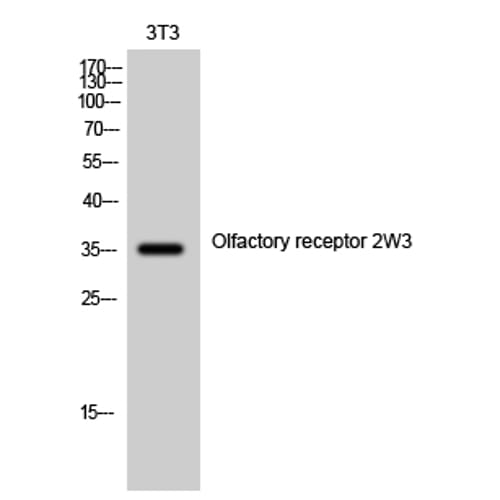
IMPORTANT NOTE This product is custom manufactured with a lead time of 3-4 weeks. Once in production, this item cannot be cancelled from an order and is not eligible for return. Target Protein Olfactory Rec. 2W3 Clonality Polyclonal Storage/Stability -20°C/1 year Application WB,ELISA Recommended Dilution Western Blot: 1/500 - 1/2000. ELISA: 1/10000. Not yet tested in other applications. Concentration 1 mg/ml Reactive Species Human Host Species Rabbit Immunogen The antiserum was produced against synthesized peptide derived from human OR2W3. AA range:141-190 Specificity Olfactory receptor 2W3 Polyclonal Antibody detects endogenous levels of Olfactory receptor 2W3 protein. Purification The antibody was affinity-purified from rabbit antiserum by affinity-chromatography using epitope-specific immunogen Form Liquid in PBS containing 50% glycerol, 0.5% BSA and 0.02% sodium azide. Gene Name OR2W3 Accession No. Q7Z3T1 Alternate Names OR2W3; OR2W3P; OR2W8P; Olfactory receptor 2W3; Olfactory receptor 2W8; Olfactory receptor OR1-49 Description olfactory receptor family 2 subfamily W member 3(OR2W3) Homo sapiens Olfactory receptors interact with odorant molecules in the nose, to initiate a neuronal response that triggers the perception of a smell. The olfactory receptor proteins are members of a large family of G-protein-coupled receptors (GPCR) arising from single coding-exon genes. Olfactory receptors share a 7-transmembrane domain structure with many neurotransmitter and hormone receptors and are responsible for the recognition and G protein-mediated transduction of odorant signals. The olfactory receptor gene family is the largest in the genome. The nomenclature assigned to the olfactory receptor genes and proteins for this organism is independent of other organisms. [provided by RefSeq, Jul 2008], Cell Pathway/ Category Olfactory transduction, Protein Expression Fetal brain, Subcellular Localization plasma membrane,integral component of membrane, Protein Function function:Odorant receptor .,similarity:Belongs to the G-protein coupled receptor 1 family., Usage For Research Use Only! Not for diagnostic or therapeutic procedures. - Reviews
| Antibody Specification | |
| Datasheet | |
| IMPORTANT NOTE | This product is custom manufactured with a lead time of 3-4 weeks. Once in production, this item cannot be cancelled from an order and is not eligible for return. |
| Target Protein | Olfactory Rec. 2W3 |
| Clonality | Polyclonal |
| Storage/Stability | -20°C/1 year |
| Application | WB,ELISA |
| Recommended Dilution | Western Blot: 1/500 - 1/2000. ELISA: 1/10000. Not yet tested in other applications. |
| Concentration | 1 mg/ml |
| Reactive Species | Human |
| Host Species | Rabbit |
| Immunogen | The antiserum was produced against synthesized peptide derived from human OR2W3. AA range:141-190 |
| Specificity | Olfactory receptor 2W3 Polyclonal Antibody detects endogenous levels of Olfactory receptor 2W3 protein. |
| Purification | The antibody was affinity-purified from rabbit antiserum by affinity-chromatography using epitope-specific immunogen |
| Form | Liquid in PBS containing 50% glycerol, 0.5% BSA and 0.02% sodium azide. |
| Gene Name | OR2W3 |
| Accession No. | Q7Z3T1 |
| Alternate Names | OR2W3; OR2W3P; OR2W8P; Olfactory receptor 2W3; Olfactory receptor 2W8; Olfactory receptor OR1-49 |
| Description | olfactory receptor family 2 subfamily W member 3(OR2W3) Homo sapiens Olfactory receptors interact with odorant molecules in the nose, to initiate a neuronal response that triggers the perception of a smell. The olfactory receptor proteins are members of a large family of G-protein-coupled receptors (GPCR) arising from single coding-exon genes. Olfactory receptors share a 7-transmembrane domain structure with many neurotransmitter and hormone receptors and are responsible for the recognition and G protein-mediated transduction of odorant signals. The olfactory receptor gene family is the largest in the genome. The nomenclature assigned to the olfactory receptor genes and proteins for this organism is independent of other organisms. [provided by RefSeq, Jul 2008], |
| Cell Pathway/ Category | Olfactory transduction, |
| Protein Expression | Fetal brain, |
| Subcellular Localization | plasma membrane,integral component of membrane, |
| Protein Function | function:Odorant receptor .,similarity:Belongs to the G-protein coupled receptor 1 family., |
| Usage | For Research Use Only! Not for diagnostic or therapeutic procedures. |