

ITT3998
ITT3998
ITT3998
from
$424.00
Price in reward points: 424
- Catalog: ITT3998
- Gene/Protein: RAN
- Product Description: Immunotag™ Ran Polyclonal Antibody
-
Description
-
Specifications
Antibody Specification Datasheet 
IMPORTANT NOTE This product is custom manufactured with a lead time of 3-4 weeks. Once in production, this item cannot be cancelled from an order and is not eligible for return. Target Protein Ran Clonality Polyclonal Storage/Stability -20°C/1 year Application WB,IHC-p,ELISA Recommended Dilution Western Blot: 1/500 - 1/2000. Immunohistochemistry: 1/100 - 1/300. ELISA: 1/10000. Not yet tested in other applications. Concentration 1 mg/ml Reactive Species Human,Mouse,Rat Host Species Rabbit Immunogen Synthesized peptide derived from Ran, at AA range: 140-220 Specificity Ran Polyclonal Antibody detects endogenous levels of Ran protein. Purification The antibody was affinity-purified from rabbit antiserum by affinity-chromatography using epitope-specific immunogen Form Liquid in PBS containing 50% glycerol, 0.5% BSA and 0.02% sodium azide. Gene Name RAN Accession No. P62826 P62827 P62828 Alternate Names RAN; ARA24; OK/SW-cl.81; GTP-binding nuclear protein Ran; Androgen receptor-associated protein 24; GTPase Ran; Ras-like protein TC4; Ras-related nuclear protein Description RAN, member RAS oncogene family(RAN) Homo sapiens RAN (ras-related nuclear protein) is a small GTP binding protein belonging to the RAS superfamily that is essential for the translocation of RNA and proteins through the nuclear pore complex. The RAN protein is also involved in control of DNA synthesis and cell cycle progression. Nuclear localization of RAN requires the presence of regulator of chromosome condensation 1 (RCC1). Mutations in RAN disrupt DNA synthesis. Because of its many functions, it is likely that RAN interacts with several other proteins. RAN regulates formation and organization of the microtubule network independently of its role in the nucleus-cytosol exchange of macromolecules. RAN could be a key signaling molecule regulating microtubule polymerization during mitosis. RCC1 generates a high local concentration of RAN-GTP around chromatin which, in turn, induces the local nucleation of microtubules. RAN is an androgen re Protein Expression Brain,Cajal-Retzius cell,Cervix carcinoma,Colon adenocarcinoma,Hippocampus, Subcellular Localization chromatin,intracellular,nucleus,nuclear pore,nucleoplasm,nucleolus,cytoplasm,centriole,cytosol,cell-cell adherens junction,membrane,midbody,extracellular matrix,melanosome,RNA nuclear exp Protein Function function:Enhances AR-mediated transactivation. Transactivation decreases as the poly-Gln length within AR increases.,function:GTP-binding protein involved in nucleocytoplasmic transport. Required for the import of protein into the nucleus and also for RNA export. Involved in chromatin condensation and control of cell cycle.,PTM:The N-terminus is blocked.,similarity:Belongs to the small GTPase superfamily. Ran family.,subcellular location:Becomes dispersed throughout the cytoplasm during mitosis. Identified by mass spectrometry in melanosome fractions from stage I to stage IV.,subunit:Monomer. Also forms a complex with CHC1 and interacts with the AR N-terminal poly-Gln region. The interaction with AR is inversely correlated with the poly-Gln length. Part of a complex consisting of RANBP9, Ran, DYRK1B and COPS5. Found in a nuclear export complex with RANBP3 and XPO1. Component of a nuclear export receptor complex composed of KPNB1, Ran, SNUPN and XPO1. Found in a trimeric export complex with SNUPN, Ran and XPO1. Interacts with RANBP10. In case of HIV-1 infection, found in a complex with HIV-1 Rev, RNAs containing a Rev response element (RRE) and XPO1. Found in a complex with HTLV-1 Rex, RANBP3 and XPO1.,tissue specificity:Expressed in a variety of tissues., Usage For Research Use Only! Not for diagnostic or therapeutic procedures. - Reviews
| Antibody Specification | |
| Datasheet | |
| IMPORTANT NOTE | This product is custom manufactured with a lead time of 3-4 weeks. Once in production, this item cannot be cancelled from an order and is not eligible for return. |
| Target Protein | Ran |
| Clonality | Polyclonal |
| Storage/Stability | -20°C/1 year |
| Application | WB,IHC-p,ELISA |
| Recommended Dilution | Western Blot: 1/500 - 1/2000. Immunohistochemistry: 1/100 - 1/300. ELISA: 1/10000. Not yet tested in other applications. |
| Concentration | 1 mg/ml |
| Reactive Species | Human,Mouse,Rat |
| Host Species | Rabbit |
| Immunogen | Synthesized peptide derived from Ran, at AA range: 140-220 |
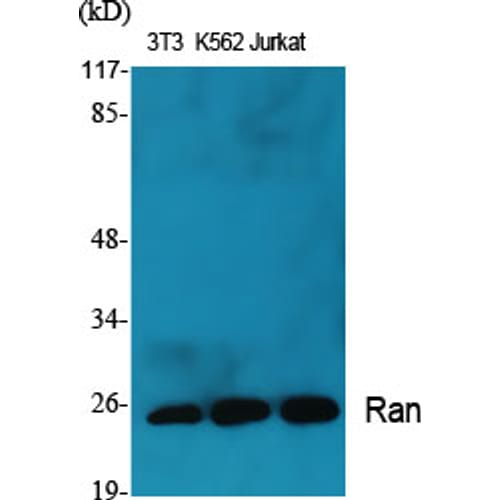
| Specificity | Ran Polyclonal Antibody detects endogenous levels of Ran protein. |
| Purification | The antibody was affinity-purified from rabbit antiserum by affinity-chromatography using epitope-specific immunogen |
| Form | Liquid in PBS containing 50% glycerol, 0.5% BSA and 0.02% sodium azide. |
| Gene Name | RAN |
| Accession No. | P62826 P62827 P62828 |
| Alternate Names | RAN; ARA24; OK/SW-cl.81; GTP-binding nuclear protein Ran; Androgen receptor-associated protein 24; GTPase Ran; Ras-like protein TC4; Ras-related nuclear protein |
| Description | RAN, member RAS oncogene family(RAN) Homo sapiens RAN (ras-related nuclear protein) is a small GTP binding protein belonging to the RAS superfamily that is essential for the translocation of RNA and proteins through the nuclear pore complex. The RAN protein is also involved in control of DNA synthesis and cell cycle progression. Nuclear localization of RAN requires the presence of regulator of chromosome condensation 1 (RCC1). Mutations in RAN disrupt DNA synthesis. Because of its many functions, it is likely that RAN interacts with several other proteins. RAN regulates formation and organization of the microtubule network independently of its role in the nucleus-cytosol exchange of macromolecules. RAN could be a key signaling molecule regulating microtubule polymerization during mitosis. RCC1 generates a high local concentration of RAN-GTP around chromatin which, in turn, induces the local nucleation of microtubules. RAN is an androgen re |
| Protein Expression | Brain,Cajal-Retzius cell,Cervix carcinoma,Colon adenocarcinoma,Hippocampus, |
| Subcellular Localization | chromatin,intracellular,nucleus,nuclear pore,nucleoplasm,nucleolus,cytoplasm,centriole,cytosol,cell-cell adherens junction,membrane,midbody,extracellular matrix,melanosome,RNA nuclear exp |
| Protein Function | function:Enhances AR-mediated transactivation. Transactivation decreases as the poly-Gln length within AR increases.,function:GTP-binding protein involved in nucleocytoplasmic transport. Required for the import of protein into the nucleus and also for RNA export. Involved in chromatin condensation and control of cell cycle.,PTM:The N-terminus is blocked.,similarity:Belongs to the small GTPase superfamily. Ran family.,subcellular location:Becomes dispersed throughout the cytoplasm during mitosis. Identified by mass spectrometry in melanosome fractions from stage I to stage IV.,subunit:Monomer. Also forms a complex with CHC1 and interacts with the AR N-terminal poly-Gln region. The interaction with AR is inversely correlated with the poly-Gln length. Part of a complex consisting of RANBP9, Ran, DYRK1B and COPS5. Found in a nuclear export complex with RANBP3 and XPO1. Component of a nuclear export receptor complex composed of KPNB1, Ran, SNUPN and XPO1. Found in a trimeric export complex with SNUPN, Ran and XPO1. Interacts with RANBP10. In case of HIV-1 infection, found in a complex with HIV-1 Rev, RNAs containing a Rev response element (RRE) and XPO1. Found in a complex with HTLV-1 Rex, RANBP3 and XPO1.,tissue specificity:Expressed in a variety of tissues., |
| Usage | For Research Use Only! Not for diagnostic or therapeutic procedures. |