

ITT4300
ITT4300
ITT4300
from
$424.00
Price in reward points: 424
- Catalog: ITT4300
- Gene/Protein: ZEB2
- Product Description: Immunotag™ SIP1 Polyclonal Antibody
-
Description
-
Specifications
Antibody Specification Datasheet 
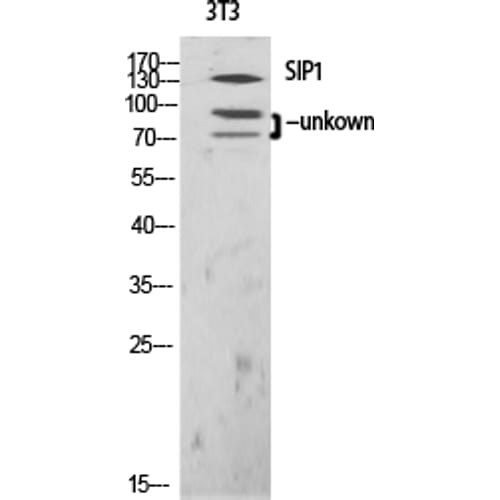
IMPORTANT NOTE This product is custom manufactured with a lead time of 3-4 weeks. Once in production, this item cannot be cancelled from an order and is not eligible for return. Target Protein SIP1 Clonality Polyclonal Storage/Stability -20°C/1 year Application WB,IHC-p,ELISA Recommended Dilution Western Blot: 1/500 - 1/2000. Immunohistochemistry: 1/100 - 1/300. ELISA: 1/10000. Not yet tested in other applications. Concentration 1 mg/ml Reactive Species Human,Mouse,Rat Host Species Rabbit Immunogen The antiserum was produced against synthesized peptide derived from human ZEB2. AA range:71-120 Specificity SIP1 Polyclonal Antibody detects endogenous levels of SIP1 protein. Purification The antibody was affinity-purified from rabbit antiserum by affinity-chromatography using epitope-specific immunogen Form Liquid in PBS containing 50% glycerol, 0.5% BSA and 0.02% sodium azide. Gene Name ZEB2 Accession No. O60315 Q9R0G7 Alternate Names ZEB2; KIAA0569; SIP1; ZFHX1B; ZFX1B; HRIHFB2411; Zinc finger E-box-binding homeobox 2; Smad-interacting protein 1; SMADIP1; Zinc finger homeobox protein 1b Description zinc finger E-box binding homeobox 2(ZEB2) Homo sapiens The protein encoded by this gene is a member of the Zfh1 family of 2-handed zinc finger/homeodomain proteins. It is located in the nucleus and functions as a DNA-binding transcriptional repressor that interacts with activated SMADs. Mutations in this gene are associated with Hirschsprung disease/Mowat-Wilson syndrome. Alternatively spliced transcript variants have been found for this gene.[provided by RefSeq, Jan 2010], Protein Expression Brain,Fetal brain, Subcellular Localization nucleus, Protein Function disease:Defects in ZEB2 are the cause of Hirschsprung disease-mental retardation syndrome (Hirschsprung disease) [MIM:235730]; also known as Mowat-Wilson syndrome (MWS). Hirschsprung disease is a rare autosomal dominant complex developmental disorder. Individuals with functional null mutations present with mental retardation, delayed motor development, epilepsy, and a wide spectrum of clinically heterogeneous features suggestive of neurocristopathies at the cephalic, cardiac, and vagal levels. Affected patients show an easily recognizable facial appearance with deep set eyes and hypertelorism, medially divergent, broad eyebrows, prominent columella, pointed chin and uplifted, notched ear lobes. Additionally, the phenotypic spectrum of facultative congenital anomalies includes short stature, microcephaly, Hirschsprung disease, malformations of the brain (agenesis of corpus callosum, cerebral atrophy) and eye (microphthalmia), seizures, congenital heart defects and genitourinary malformations, in particular hypospadias. The development of psychomotor skills and speech is delayed in most patients. Overall, the grade of mental retardation is at least moderate, but usually severe including characteristic abnormal behavior.,function:Transcriptional inhibitor that binds to DNA sequence 5'-CACCT-3' in different promoters. Represses transcription of E-cadherin.,PTM:Sumoylation on Lys-391 and Lys-866 is promoted by the E3 SUMO-protein ligase CBX4, and impairs interaction with CTBP1 and transcription repression activity.,similarity:Belongs to the delta-EF1/ZFH-1 C2H2-type zinc-finger family.,similarity:Contains 1 homeobox DNA-binding domain.,similarity:Contains 7 C2H2-type zinc fingers.,subunit:Binds activated SMAD1, activated SMAD2 and activated SMAD3; binding with SMAD4 is not detected (By similarity). Interacts with CBX4 and CTBP1., Usage For Research Use Only! Not for diagnostic or therapeutic procedures. - Reviews
| Antibody Specification | |
| Datasheet | |
| IMPORTANT NOTE | This product is custom manufactured with a lead time of 3-4 weeks. Once in production, this item cannot be cancelled from an order and is not eligible for return. |
| Target Protein | SIP1 |
| Clonality | Polyclonal |
| Storage/Stability | -20°C/1 year |
| Application | WB,IHC-p,ELISA |
| Recommended Dilution | Western Blot: 1/500 - 1/2000. Immunohistochemistry: 1/100 - 1/300. ELISA: 1/10000. Not yet tested in other applications. |
| Concentration | 1 mg/ml |
| Reactive Species | Human,Mouse,Rat |
| Host Species | Rabbit |
| Immunogen | The antiserum was produced against synthesized peptide derived from human ZEB2. AA range:71-120 |
| Specificity | SIP1 Polyclonal Antibody detects endogenous levels of SIP1 protein. |
| Purification | The antibody was affinity-purified from rabbit antiserum by affinity-chromatography using epitope-specific immunogen |
| Form | Liquid in PBS containing 50% glycerol, 0.5% BSA and 0.02% sodium azide. |
| Gene Name | ZEB2 |
| Accession No. | O60315 Q9R0G7 |
| Alternate Names | ZEB2; KIAA0569; SIP1; ZFHX1B; ZFX1B; HRIHFB2411; Zinc finger E-box-binding homeobox 2; Smad-interacting protein 1; SMADIP1; Zinc finger homeobox protein 1b |
| Description | zinc finger E-box binding homeobox 2(ZEB2) Homo sapiens The protein encoded by this gene is a member of the Zfh1 family of 2-handed zinc finger/homeodomain proteins. It is located in the nucleus and functions as a DNA-binding transcriptional repressor that interacts with activated SMADs. Mutations in this gene are associated with Hirschsprung disease/Mowat-Wilson syndrome. Alternatively spliced transcript variants have been found for this gene.[provided by RefSeq, Jan 2010], |
| Protein Expression | Brain,Fetal brain, |
| Subcellular Localization | nucleus, |
| Protein Function | disease:Defects in ZEB2 are the cause of Hirschsprung disease-mental retardation syndrome (Hirschsprung disease) [MIM:235730]; also known as Mowat-Wilson syndrome (MWS). Hirschsprung disease is a rare autosomal dominant complex developmental disorder. Individuals with functional null mutations present with mental retardation, delayed motor development, epilepsy, and a wide spectrum of clinically heterogeneous features suggestive of neurocristopathies at the cephalic, cardiac, and vagal levels. Affected patients show an easily recognizable facial appearance with deep set eyes and hypertelorism, medially divergent, broad eyebrows, prominent columella, pointed chin and uplifted, notched ear lobes. Additionally, the phenotypic spectrum of facultative congenital anomalies includes short stature, microcephaly, Hirschsprung disease, malformations of the brain (agenesis of corpus callosum, cerebral atrophy) and eye (microphthalmia), seizures, congenital heart defects and genitourinary malformations, in particular hypospadias. The development of psychomotor skills and speech is delayed in most patients. Overall, the grade of mental retardation is at least moderate, but usually severe including characteristic abnormal behavior.,function:Transcriptional inhibitor that binds to DNA sequence 5'-CACCT-3' in different promoters. Represses transcription of E-cadherin.,PTM:Sumoylation on Lys-391 and Lys-866 is promoted by the E3 SUMO-protein ligase CBX4, and impairs interaction with CTBP1 and transcription repression activity.,similarity:Belongs to the delta-EF1/ZFH-1 C2H2-type zinc-finger family.,similarity:Contains 1 homeobox DNA-binding domain.,similarity:Contains 7 C2H2-type zinc fingers.,subunit:Binds activated SMAD1, activated SMAD2 and activated SMAD3; binding with SMAD4 is not detected (By similarity). Interacts with CBX4 and CTBP1., |
| Usage | For Research Use Only! Not for diagnostic or therapeutic procedures. |