

ITT4343
ITT4343
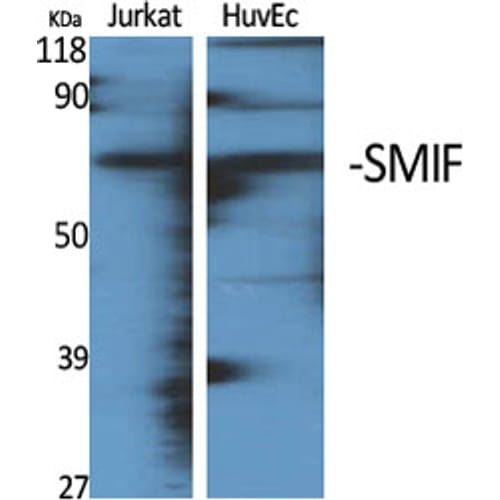
ITT4343
from
$424.00
Price in reward points: 424
- Catalog: ITT4343
- Gene/Protein: DCP1A
- Product Description: Immunotag™ SMIF Polyclonal Antibody
-
Description
-
Specifications
Antibody Specification Datasheet 
IMPORTANT NOTE This product is custom manufactured with a lead time of 3-4 weeks. Once in production, this item cannot be cancelled from an order and is not eligible for return. Target Protein SMIF Clonality Polyclonal Storage/Stability -20°C/1 year Application WB,IHC-p,ELISA Recommended Dilution Western Blot: 1/500 - 1/2000. Immunohistochemistry: 1/100 - 1/300. ELISA: 1/20000. Not yet tested in other applications. Concentration 1 mg/ml Reactive Species Human,Mouse Host Species Rabbit Immunogen The antiserum was produced against synthesized peptide derived from human DCP1A. AA range:111-160 Specificity SMIF Polyclonal Antibody detects endogenous levels of SMIF protein. Purification The antibody was affinity-purified from rabbit antiserum by affinity-chromatography using epitope-specific immunogen Form Liquid in PBS containing 50% glycerol, 0.5% BSA and 0.02% sodium azide. Gene Name DCP1A Accession No. Q9NPI6 Q91YD3 Alternate Names DCP1A; SMIF; mRNA-decapping enzyme 1A; Smad4-interacting transcriptional co-activator; Transcription factor SMIF Description decapping mRNA 1A(DCP1A) Homo sapiens Decapping is a key step in general and regulated mRNA decay. The protein encoded by this gene is a decapping enzyme. This protein and another decapping enzyme form a decapping complex, which interacts with the nonsense-mediated decay factor hUpf1 and may be recruited to mRNAs containing premature termination codons. This protein also participates in the TGF-beta signaling pathway. Alternative splicing of this gene results in multiple transcript variants. [provided by RefSeq, Feb 2014], Cell Pathway/ Category RNA degradation, Protein Expression Epithelium,Muscle,Pancreas,Placenta, Subcellular Localization cytoplasmic mRNA processing body,nucleus,cytoplasm,cytosol,membrane,intracellular membrane-bounded organelle, Protein Function function:Necessary for the degradation of mRNAs, both in normal mRNA turnover and in nonsense-mediated mRNA decay. Removes the 7-methyl guanine cap structure from mRNA molecules, yielding a 5'-phosphorylated mRNA fragment and 7m-GDP. Contributes to the transactivation of target genes after stimulation by TGFB1.,similarity:Belongs to the DCP1 family.,subcellular location:Predominantly cytoplasmic, in processing bodies (PB). Nuclear, after TGFB1 treatment. Translocation to the nucleus depends on interaction with SMAD4.,subunit:Forms a complex with EDC3, DCP2, DDX6 and EDC4/HEDLS, within this complex directly interacts with EDC3. Binds DCP1B, UPF1 and SMAD4. Part of a cytoplasmic complex containing proteins involved in mRNA decay, including XRN1 and LSM1. Interacts with PNRC2.,tissue specificity:Detected in heart, brain, placenta, lung, skeletal muscle, liver, kidney and pancreas., Usage For Research Use Only! Not for diagnostic or therapeutic procedures. - Reviews
| Antibody Specification | |
| Datasheet | |
| IMPORTANT NOTE | This product is custom manufactured with a lead time of 3-4 weeks. Once in production, this item cannot be cancelled from an order and is not eligible for return. |
| Target Protein | SMIF |
| Clonality | Polyclonal |
| Storage/Stability | -20°C/1 year |
| Application | WB,IHC-p,ELISA |
| Recommended Dilution | Western Blot: 1/500 - 1/2000. Immunohistochemistry: 1/100 - 1/300. ELISA: 1/20000. Not yet tested in other applications. |
| Concentration | 1 mg/ml |
| Reactive Species | Human,Mouse |
| Host Species | Rabbit |
| Immunogen | The antiserum was produced against synthesized peptide derived from human DCP1A. AA range:111-160 |
| Specificity | SMIF Polyclonal Antibody detects endogenous levels of SMIF protein. |
| Purification | The antibody was affinity-purified from rabbit antiserum by affinity-chromatography using epitope-specific immunogen |
| Form | Liquid in PBS containing 50% glycerol, 0.5% BSA and 0.02% sodium azide. |
| Gene Name | DCP1A |
| Accession No. | Q9NPI6 Q91YD3 |
| Alternate Names | DCP1A; SMIF; mRNA-decapping enzyme 1A; Smad4-interacting transcriptional co-activator; Transcription factor SMIF |
| Description | decapping mRNA 1A(DCP1A) Homo sapiens Decapping is a key step in general and regulated mRNA decay. The protein encoded by this gene is a decapping enzyme. This protein and another decapping enzyme form a decapping complex, which interacts with the nonsense-mediated decay factor hUpf1 and may be recruited to mRNAs containing premature termination codons. This protein also participates in the TGF-beta signaling pathway. Alternative splicing of this gene results in multiple transcript variants. [provided by RefSeq, Feb 2014], |
| Cell Pathway/ Category | RNA degradation, |
| Protein Expression | Epithelium,Muscle,Pancreas,Placenta, |
| Subcellular Localization | cytoplasmic mRNA processing body,nucleus,cytoplasm,cytosol,membrane,intracellular membrane-bounded organelle, |
| Protein Function | function:Necessary for the degradation of mRNAs, both in normal mRNA turnover and in nonsense-mediated mRNA decay. Removes the 7-methyl guanine cap structure from mRNA molecules, yielding a 5'-phosphorylated mRNA fragment and 7m-GDP. Contributes to the transactivation of target genes after stimulation by TGFB1.,similarity:Belongs to the DCP1 family.,subcellular location:Predominantly cytoplasmic, in processing bodies (PB). Nuclear, after TGFB1 treatment. Translocation to the nucleus depends on interaction with SMAD4.,subunit:Forms a complex with EDC3, DCP2, DDX6 and EDC4/HEDLS, within this complex directly interacts with EDC3. Binds DCP1B, UPF1 and SMAD4. Part of a cytoplasmic complex containing proteins involved in mRNA decay, including XRN1 and LSM1. Interacts with PNRC2.,tissue specificity:Detected in heart, brain, placenta, lung, skeletal muscle, liver, kidney and pancreas., |
| Usage | For Research Use Only! Not for diagnostic or therapeutic procedures. |