

ITT5596
ITT5596
ITT5596
from
$424.00
Price in reward points: 424
- Catalog: ITT5596
- Gene/Protein: LILRB1
- Product Description: Immunotag™ LIR-1 Polyclonal Antibody
-
Description
-
Specifications
Antibody Specification Datasheet 
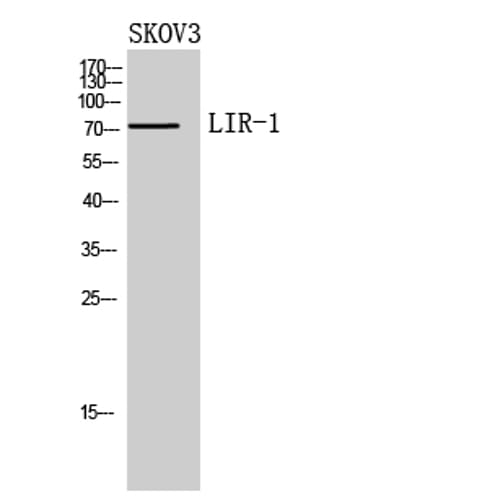
IMPORTANT NOTE This product is custom manufactured with a lead time of 3-4 weeks. Once in production, this item cannot be cancelled from an order and is not eligible for return. Target Protein LIR-1 Clonality Polyclonal Storage/Stability -20°C/1 year Application WB,ELISA Recommended Dilution Western Blot: 1/500 - 1/2000. ELISA: 1/10000. Not yet tested in other applications. Concentration 1 mg/ml Reactive Species Human Host Species Rabbit Immunogen The antiserum was produced against synthesized peptide derived from the N-terminal region of human LILRB1. AA range:21-70 Specificity LIR-1 Polyclonal Antibody detects endogenous levels of LIR-1 protein. Purification The antibody was affinity-purified from rabbit antiserum by affinity-chromatography using epitope-specific immunogen Form Liquid in PBS containing 50% glycerol, 0.5% BSA and 0.02% sodium azide. Gene Name LILRB1 Accession No. Q8NHL6 Alternate Names LILRB1; ILT2; LIR1; MIR7; Leukocyte immunoglobulin-like receptor subfamily B member 1; LIR-1; Leukocyte immunoglobulin-like receptor 1; CD85 antigen-like family member J; Immunoglobulin-like transcript 2; ILT-2; Monocyte/macrophage immunoglobulin-like receptor 7; MIR-7; CD85j Description leukocyte immunoglobulin like receptor B1(LILRB1) Homo sapiens This gene is a member of the leukocyte immunoglobulin-like receptor (LIR) family, which is found in a gene cluster at chromosomal region 19q13.4. The encoded protein belongs to the subfamily B class of LIR receptors which contain two or four extracellular immunoglobulin domains, a transmembrane domain, and two to four cytoplasmic immunoreceptor tyrosine-based inhibitory motifs (ITIMs). The receptor is expressed on immune cells where it binds to MHC class I molecules on antigen-presenting cells and transduces a negative signal that inhibits stimulation of an immune response. It is thought to control inflammatory responses and cytotoxicity to help focus the immune response and limit autoreactivity. Multiple transcript variants encoding different isoforms have been found for this gene. [provided by RefSeq, Jul 2008], Protein Expression B-cell,Lymphoblast, Subcellular Localization extracellular region,cytoplasm,plasma membrane,external side of plasma membrane,integral component of membrane, Protein Function domain:Contains 4 copies of a cytoplasmic motif that is referred to as the immunoreceptor tyrosine-based inhibitor motif (ITIM). This motif is involved in modulation of cellular responses. The phosphorylated ITIM motif can bind the SH2 domain of several SH2-containing phosphatases.,function:Receptor for class I MHC antigens. Recognizes a broad spectrum of HLA-A, HLA-B, HLA-C and HLA-G alleles. Receptor for H301/UL18, a human cytomegalovirus class I MHC homolog. Ligand binding results in inhibitory signals and down-regulation of the immune response. Engagement of LILRB1 present on natural killer cells or T-cells by class I MHC molecules protects the target cells from lysis. Interaction with HLA-B or HLA-E leads to inhibition of the signal triggered by FCER1A and inhibits serotonin release. Inhibits FCGR1A-mediated phosphorylation of cellular proteins and mobilization of intracellular calcium ions.,PTM:Phosphorylated on tyrosine residues. Dephosphorylated by PTPN6.,similarity:Contains 4 Ig-like C2-type (immunoglobulin-like) domains.,subunit:Binds PTPN6 when phosphorylated. Binds FCER1A and FCGR1A.,tissue specificity:Expressed predominantly on B-cells and monocytes, and at lower levels on dendritic cells. Detected on a low percentage of T-cells and natural killer (NK) cells., Usage For Research Use Only! Not for diagnostic or therapeutic procedures. - Reviews
| Antibody Specification | |
| Datasheet | |
| IMPORTANT NOTE | This product is custom manufactured with a lead time of 3-4 weeks. Once in production, this item cannot be cancelled from an order and is not eligible for return. |
| Target Protein | LIR-1 |
| Clonality | Polyclonal |
| Storage/Stability | -20°C/1 year |
| Application | WB,ELISA |
| Recommended Dilution | Western Blot: 1/500 - 1/2000. ELISA: 1/10000. Not yet tested in other applications. |
| Concentration | 1 mg/ml |
| Reactive Species | Human |
| Host Species | Rabbit |
| Immunogen | The antiserum was produced against synthesized peptide derived from the N-terminal region of human LILRB1. AA range:21-70 |
| Specificity | LIR-1 Polyclonal Antibody detects endogenous levels of LIR-1 protein. |
| Purification | The antibody was affinity-purified from rabbit antiserum by affinity-chromatography using epitope-specific immunogen |
| Form | Liquid in PBS containing 50% glycerol, 0.5% BSA and 0.02% sodium azide. |
| Gene Name | LILRB1 |
| Accession No. | Q8NHL6 |
| Alternate Names | LILRB1; ILT2; LIR1; MIR7; Leukocyte immunoglobulin-like receptor subfamily B member 1; LIR-1; Leukocyte immunoglobulin-like receptor 1; CD85 antigen-like family member J; Immunoglobulin-like transcript 2; ILT-2; Monocyte/macrophage immunoglobulin-like receptor 7; MIR-7; CD85j |
| Description | leukocyte immunoglobulin like receptor B1(LILRB1) Homo sapiens This gene is a member of the leukocyte immunoglobulin-like receptor (LIR) family, which is found in a gene cluster at chromosomal region 19q13.4. The encoded protein belongs to the subfamily B class of LIR receptors which contain two or four extracellular immunoglobulin domains, a transmembrane domain, and two to four cytoplasmic immunoreceptor tyrosine-based inhibitory motifs (ITIMs). The receptor is expressed on immune cells where it binds to MHC class I molecules on antigen-presenting cells and transduces a negative signal that inhibits stimulation of an immune response. It is thought to control inflammatory responses and cytotoxicity to help focus the immune response and limit autoreactivity. Multiple transcript variants encoding different isoforms have been found for this gene. [provided by RefSeq, Jul 2008], |
| Protein Expression | B-cell,Lymphoblast, |
| Subcellular Localization | extracellular region,cytoplasm,plasma membrane,external side of plasma membrane,integral component of membrane, |
| Protein Function | domain:Contains 4 copies of a cytoplasmic motif that is referred to as the immunoreceptor tyrosine-based inhibitor motif (ITIM). This motif is involved in modulation of cellular responses. The phosphorylated ITIM motif can bind the SH2 domain of several SH2-containing phosphatases.,function:Receptor for class I MHC antigens. Recognizes a broad spectrum of HLA-A, HLA-B, HLA-C and HLA-G alleles. Receptor for H301/UL18, a human cytomegalovirus class I MHC homolog. Ligand binding results in inhibitory signals and down-regulation of the immune response. Engagement of LILRB1 present on natural killer cells or T-cells by class I MHC molecules protects the target cells from lysis. Interaction with HLA-B or HLA-E leads to inhibition of the signal triggered by FCER1A and inhibits serotonin release. Inhibits FCGR1A-mediated phosphorylation of cellular proteins and mobilization of intracellular calcium ions.,PTM:Phosphorylated on tyrosine residues. Dephosphorylated by PTPN6.,similarity:Contains 4 Ig-like C2-type (immunoglobulin-like) domains.,subunit:Binds PTPN6 when phosphorylated. Binds FCER1A and FCGR1A.,tissue specificity:Expressed predominantly on B-cells and monocytes, and at lower levels on dendritic cells. Detected on a low percentage of T-cells and natural killer (NK) cells., |
| Usage | For Research Use Only! Not for diagnostic or therapeutic procedures. |